Engelandvaarders and Refugees:
The passengers and 'crew' of the Zeemanshoop
Europe
was turned upside down in May 1940 when the phoney war ended and
German forces parachuted into the Netherlands and swept through Belgium
and into France. Ordinary people caught up in the events of that month
made decisions which changed the course of their lives for ever.The
most desperate to escape before their countries were overran were the
Jews. The Netherlands had remained neutral during the last war and many German Jews thought it would be a safe haven. Between the Nazis coming to power in Germany in 1933 and 1938 about
twenty five thousand Jews left Germany to seek refuge in the
Netherlands. Chance brought the 46 passengers and crew of the Zeemanshoop
together on the evening of Tuesday the 14 May 1940 after the surrender of the Netherlands was broadcast on Dutch radio. More than half were
Jewish. They escaped with their lives but often left their families as
well as their
homes behind. Some were refugees from Germany or
Austria who had found
safety in the Netherlands only to have to flee again. They also wanted
to play their part in the defeat
of Nazi Germany. They included women, high school students and
older men.
On arrival in Britain the refugees from Germany were treated
as enemy aliens and interned. Otto Neurath had an international reputation but most
were anonymous men and women of importance only to their friends and
families. Anybody researching family members with German nationality who arrived in
England from the continent in 1940 should start by reading the National
Archives guide to Internees in Britain during the Second World War.
Most of the passengers were Dutch but many of them were Jews. Marien de Jonge who left behind a wife and a two week old son and the students who crewed the lifeboat were
not Jews and their only motivation for leaving their homes was to fight
for
their country. The
Dutch called their fellow countrymen who left for England after the
surrender of Dutch forces to fight for the liberation of the
Netherlands Engelandvaarders (England Travelers). But where whole families left together, including women
and the elderly, it seems reasonable to assume that they were
Jewish. They left to save their lives but were also keen to serve their country by joining
the armed services or if too old to fight in some other capacity.
I would like to hear from the families of the following passengers
Jacob Meier
(or Meyer) described by Harry Hack as a "Koopman (merchant) in London",
Meuleman and wife, Singer (assumed to be male), three women and a man
with a name which has been variously interpreted as Von Arnheim /
Aruheim or Von Stroheim, Van Wezel and a Czech name which looks like P.
Zaitschek but is probably Zajíček.
Their names were recorded on the sea chart during
the voyage but they have not been traced and I would be grateful to
anybody who can identify them and provide further information.
The stories of the passengers and crew are told here, often by members of their
own families who might not have been born had their parents not escaped.But if you have not already done so you should start by reading the story of the voyage of the Zeemanshoop and their rescue by HMS Venomous.And if you can add anything to this account of their lives please e-mail the publisher.
Bill Forster
Holywell House Publishing
Name index for families
Where no link is provided no details are known at this time
Willem George Belinfante and his sister Ada Juliette Belinfante
Wim Belinfante was born on the 8 October 1904 at s Gravenhage,
the son of Jacob Willem Belinfante (1873-1943) and Clothilde
Oppenheimer (1881-1974). He had two sisters: Dora Nellie Belinfante
born in 1907 and Ada Juliette Belinfante born 1911. He was a prominent member of the Portuguese Jewish community and his family had lived in The Hague for nearly two hundred years.
Willem, known as 'Wim' Belinfante, was a 36 year old Councilor at the Department of Justice when he
and his 29 year old sister Ada left Scheveningen aboard the Zeemanshoop.Interviewed
on Dutch radio he described cycling to Scheveningen at 8.30 in the
evening of Tuesday 14 May. They had 600 Guilders to pay for their trip
(but the students would not take any money) and part of a collection of
coins. They had no other luggage.
"We saw that the life boat Zeemanshoop
was ready to departure. I asked one of the bystanders 'where will
that little boat go to?' and somebody answered 'to England'. On asking
'Is there any place left?' someone answered 'if I were you, I would
jump on board.' And so we did. It must have been about a quarter to
nine, and at approximately 8.55 the boat pushed off." From a letter written by Belinfante to the ZHRM on the 21 January 1946.
Their sister, Dora Nellie Belinfante
('Do'),
was unable to escape. She and their Mother were sent to
the Dutch holding camp for Jews at Westerbork and from there to
Theresienstadt
(Terezin) concentration camp in what is now the Czech Republic but
survived.
Wim Belinfante worked for the Ministry of Justice in London and two of the other passengers on the Zeemanshoop, Werner Goldschmidt and his wife Ines
Goldschmidt-Daniels, worked for him at the Ministry, Werner Goldschmidt
as a legislator and his wife Ines as his personal secretary. Further
details will be included in a forthcoming book on the Ministry of
Justice while based in London during the war.
Wim and Ada Belinfante returned to
the Netherlands when the war ended and lived with his two sisters and
their Mother at the stately parental home on the Statenplein. Non of them married and there
are no close relatives alive today. Willem never forgot that he owed his
life and that of his sister to the Zeemanshoop. On the 21 January 1946 he wrote to Th de Booy, Secretary of the KNRM (Dutch Lifeboat Association), describing the voyage of the Zeemanshoop (translated into English by Radboud Hack) and on his death aged 92 at s Gravenhage on the 3 February 1997 he left a
legacy
to pay for a new lifeboat named Zeemanshoop. It was launched in 2000 by his 93 year old sister, 'Do' Belinfante, at Breskens at the mouth of the Scheldt.
Dora Nellie Belinfante at the launch of the new Zeemanshoop at Breskens on the River Scheldt in 2000
Courtesy of the KNRM
John Blitz
Blitz was the partner of Ro Cohen, the sister of Anna Velmans. He was
the buyer of textiles in the "Bijenkorf" (Beehive), Amsterdam, Hollands
largest department store. After arrival in the Dutch East Indies in late 1940 he went into business with Jo Velmans, Anna Velmans husband, importing textiles from the USA. He died in a civilian prison
camp during the Japanese occupation of the Dutch East Indies (now
Indonesia).
Jo
Bongaerts and Karel Dahmen grew up together at Roermond in the south
east of the Netherlands near the German border. They became good
friends and were both students at Delft University when Germany invaded
the Netherlands. They escaped to England aboard the Zeemanshoop and briefly served on Dutch merchant ships but their lives then took different paths.
Jo Bongaerts enlisted in the Marine Luchtvaart Dienst
(MLD), the air force of the Royal Netherland Navy,
and trained as a pilot in the Dutch East Indies. On returning to
Britain he was retrained by the RAF as a navigator and served in
Mitchell B25 bombers with 320 Squadron. He was severely injured when
his plane crash landed on the 25 October 1943 returning from a raid on
a German airfield near Brest and was awarded the DFC. He told his son
that “I couldn’t let my friends go to war, alone!”
and after eight months in hospital and rehabilitation he retrained as
second pilot and returned to active service with 320 Squadron.
He took part in many operations in support of land forces as they
advanced through France and into the Netherlands, including the bombing
of the bridges over the River Meuse at his home town of Roermond.
Shortly after the liberation of the Netherlands he returned to Roermond
and married his fiancée Elly Wong, the daughter of the town's much
loved doctor. He ended the war as commander of the Gilzen Rijen airbase
between Breda and Tilburg. Lt J.M. Bongaerts DFC, FC, OHK1 was
discharged
from the Royal Netherlands Navy Reserve on the 16 August 1947.
He returned to the University of Delft to complete his degree in civil
engineering and joined Shell who posted him to the Dutch East Indies as
a pipeline engineer with Bataafse Petroleum Maatschappij. His
job took him to Java, Borneo and Sumatra and he lived with Elly in
Dutch compounds where the local staff helped her look after three
adopted children, two boys and a girl. When conditions became difficult
after Sukarno came to power Shell recalled him to the Netherlands in
1961 and made him General Manager of the Nederlandse Aardolie Maatschappij
(Netherlands Oil Company), jointly owned by Shell and Esso, just two
years
after NAM struck gas in the province of Groningen in the north east
of the Netherlands. He spent the next twelve years developing the
fields to
supply
natural gas to Holland and Western Europe. This key position made him
an important contributor to the economic developement of the
Netherlands. He
was appointed as Director of Shell Netherlands in 1966 and retired in
August 1974 but continued to be called upon as an adviser to major
Dutch companies. He died at his home in Assen on the 26 December 1989.
Click on his name above for a more detailed account of the life of a
modest war hero who made a major contribution to the postwar prosperity
of the Netherlands illustrated with some remarkable wartime photographs
of his service with RAF Squadron 320, the Dutch Squadron.
Ro Cohen
Ro was the youngest sister of Anna Velmans and the mother of Dick Speijer. She had divorced her husband and lived with her son and her partner, John Blitz, in the house of her married sister, Aal Drukkker.
She worked in the purchasing department of the Bijenkorf department
store in Amsterdam where her sister Anna was a buyer and department
head. Ro Cohen survived three and a half years of imprisonment by
the Japanese in a camp for women on Java.
After the war she resumed her job in The Hague branch of the Bijenkorf
department store, retired to Amsterdam and died in her early seventies.
Karel Rene Dahmen Karel Dahmen was one of the four students who deserve most of the credit for bringing the Zeemanshoop and its passengers to safety. His
decision to cycle from Delft to Scheveningen after hearing the
broadcast announcement of the surrender of Netherlands forces changed
the course of his life. After arrival at Dover aboard HMS Venomous he joined theSS Jupiterunder Captain Dekker as assistant engineer before joining the Royal Netherlands Navy as an Ordinary Seaman (OD) on theHNMS Jacob van Heemskerkwhere he became the RDF Operator.
After
officer training Sub Lt Karel Dahmen was posted to the Dutch Naval
Liaison Office at the Admiralty but was released to briefly serve on theHNMS Isaac Sweers. In the Spring of 1943 he was posted to the RNN9th MTB Flotillaat Dover training RDF operators and developing tactics for attacking
German convoys in the Channel. He was then sent to the USA
to train with the US Marines and the SeaBeas to create aDutch Marine Brigadeto regain control of the Dutch East Indies after the defeat of Japan.
Karel Dahmen describes his marriage and postwar career as an oilfield
engineer withStanvac Easternin Sumatra and with theContinental Carbon Companyin
the Netherlands and the USA where he moved in 1967. Karel Dahmen
retained his Dutch nationality all his life and died aged 101 in Austin, Texas, on 16 February 2021. To read the full
account of his life click on his name above. Charlotte Daniels (née Nachmann) Charlotte Daniels-Nachmann married Gustav G. Daniels, the Director of a shipping company in Rotterdam, and was the Mother of Inès and Edgar Daniels. Her daughter Inès married Werner Goldschmidt. Since Charlotte's husband had died in 1922 she left for England with her daughter and son in law, on the Zeemanshoop and lived in London until she returned to The Hague in 1945. She died at Rotterdam in 1970.
'Max' and his wife 'Aal', Anna Velmans'
oldest sister, lived in
Scheveningen, the seaside resort of The Hague, on the same street as
Jo, Anna and Loet Velmans. Max worked in the wholesale fur trade.
Antwerp and Amsterdam were the centres for cutting and polishing
diamonds, while London was the hub for selling them. As the threat of
German invasion grew in the 1930s, some firms moved from the Low
Countries to southern England, but were relocated to North Wales to
escape wartime air raids. After
arrival in Britain the Drukker's lived in Llandudno where Max had found
work as
a diamond polisher, a trade he learned as a young man. They stayed in
London for a year or two after the war before returning to their house
in Scheveningen where they died.
Wolfgang Fischer and his wife, Irene Fischer(née Goldschmidt) Wolfgang Julius Fischer was born in Berlin on the 5 December
1914, emigrated to the Netherlands and acquired Dutch citizenship. He
married Irene Elisabeth Goldschmidt on the 20 October 1939. As a Dutch
citizen he was not subject to internment on arrival in England and served in the military.
After the war he returned to the Netherlands and worked as an insurance
agent in The Hague and in the Dutch colony of Curacao from
approximately 1948-53. They were divorced in 1958 and his date of death
is not known.
His wife, Irene Elisabeth Goldschmidt, was born in Berlin on the
11 March 1917. She emigrated to the Netherlands in 1933
and studied Physical Education and Medical Gymnastics, obtaining
diplomas in both, and taught physical training to youth clubs. She entered the service of Netherlands Government in
London, studied the rehabilitation of the handicapped and undertook
practical work in English hospitals and rehabilitation centres.
They returned to the Netherlands in 1945 and she worked at the
Department of Health until she accompanied her husband Wolfgang Fischer
to Curacao in 1948 where she worked as a therapist. After their
divorce in 1958 she worked in Israel for two years as a hospital
physiotherapist. On returning to the Netherlands she lived in The Hague
and worked privately as a physiotherapist and as a secretary at the
Embassy of Israel until about 1987.She worked as a volunteer for Amnesty Internationaluntil a great age but late in her long life she suffered from dementia. She was 99 when she died in the Hague on 17 April 2016.
Dr Gustav Goldschmidt and his wife, Gertrud Goldschmidt (née Arnheim)
Gustav Alexander
Georg Goldschmidt (on right) was born in Berlin on the 25 April 1878. He
studied law at universities in Berlin, London and Paris (Sorbonne) and
practiced law in Berlin. He married Gertrud Therese Arnheim, a 23 year
old nursery school teacher, on the 19 June 1911 and they had two
children, Werner and Irene. In 1915 he was conscripted into the German
army and because of his knowledge of languages he was given the job of
"eavesdropping" on radio transmissions of British and French army units in
France. After the war he returned to his law practice in Berlin and
was closely associated with Dr Oscar Cohn, a social democrat member of Parliament.
In 1930 he was appointed Legal Advisor to the Minister of Justice.
When the Nazi party took over in 1933 he was dismissed because he was a
member of the Social Democratic Party (SPD) and his father was Jewish.
Gustav and Gertrude emigrated to the Netherlands along with their son,
Werner Goldschmidt, by then a law student, and their sixteen year old daughter,
Irene. They lived in The Hague and
he worked in the Peace Palace, where the law courts sat (and where the
International Court of
Justice now meets). He had retained his German nationality when he
moved to the Netherlands but on the 28 January 1939 he became stateless
when the German government cancelled his passport. By then his son
Werner was married to Ines Daniels and his daughter, Irene, to Wolfgang Fischer,
both members of Jewish families. When Germany invaded the Netherlands
on the 10 May 1940 Gustav knew he and his family had to escape to
England if they were to survive.
Having fled Germany for the Netherlands it must have come as a terrible shock having to flee a second time but the entire family was extraordinary fortunate to find places aboard the Zeemanshoop. On being landed at Dover by HMS Venomous
on the 15 May the Dutch nationals left for London by train and were
taken care of by the Netherlands Emergency Committee. Gustav and his
wife were stateless but born in Germany; his son had a German passport
and his Dutch wife lost her Dutch nationality when they married. They
were "enemy aliens" and were taken to the police station, interrogated
and held overnight. The following day they were taken to London by
train and husbands and wives were separated, most of the men were sent to
Pentonville prison in north London and the women to Holloway, a prison for women.
Gustav was sent to the Oratory Schools Internment Camp, in Stewarts
Grove, Chelsea, as an interpreter which may have led to insulting
encounters with committed Nazis. He had taken the
precaution of boarding the Zeemanshoop with
a poison capsule and tragically he now decided to end his life. He
was taken to St Luke's Hospital in Chelsea and his wife and daughter in
law
were allowed to visit him but he could not be saved and died on the 20
May 1940. The death certificate recorded: "The cause of death:
Barbiturate Veronal and Dial poisoning (self Administered). Did kill
himself while the balance of his mind was disturbed". His son
Werner was not informed of his death and the family were not allowed to
attend his funeral and do not know where he is buried.
The Goldschmidt family were sent by train to Liverpool and by ferry to the Isle of Man in the Irish Sea where German
nationals from all over Britain were interned in requisitioned boarding
houses and small hotels. Gertrude Goldschmidt (on left) went mad with grief and
for a period was put in an asylum where she was treated harshly without any
sympathy or
understanding of her feelings. She was released from internment in
September and lived
in London until her return to The Hague in 1945 and died there on
the 1 March 1970.
Werner Goldschmidt and his wife, Inès Goldschmidt (née Daniels) Werner Julius Walter Goldschmidt
was born in
Berlin on the 11 May 1913 and studied law in Berlin and Heidelberg. He
was active in the Socialist Youth Movement and when the National
Socialists came to power in 1933 he immediately emmigrated to the
Netherlands and when his father lost his position
at
the Ministry of Justice later that year the entire family decided to join him.
He restarted his law studies - in Dutch - at the University of Leiden
and on qualifying cum laude in 1935 as LL.M (Master of Law) joined the law firm of
Arnold Hijman and Amandus Wolfsbergen in Rotterdam and remained with them until 1940.
He married Inès Jeanne Daniels (left), the daughter of Gustav Daniels (on right), a Director of a
shipping company in 1938 (on right). She was a Jew, born in Antwerp in 1910 but
had been
living in Rotterdam since 1913 and had Dutch nationality. In November
Werner renounced his German nationality and applied for Dutch
citizenship but his application was still pending in May 1940. They
left Rotterdam on the 14 May to join his parents at their home in The
Hague just
hours before the German Sicherheitsdienst (SD, security service), called at their home.
The whole family went to Scheveningen and succeeded in getting a place
on the over crowded Dutch lifeboat.
On disembarking from HMS Venomous at Dover they were held at the police station overnight and were sent to London by train the following day. Inès
had lost her Dutch nationality when they married and they were all
detained as "enemy aliens". Werner was held at Pentonville and his wife at Holloway. He was not told that his father, Gustav
Goldschmidt, took poison and died on the 20 May, less than a week after
landing in England. The family were eventually sent to the Isle of Man where they were interned in different camps.
Diplomatic
action by the Dutch ministry of Justice, the Dutch Ministry of War and
the British Ministry of War led to their release in
1941. Inès Goldschmidt in January when she gained employment in the
canteen of the
barracks of the Princess Irene Brigade in Wolverhampton and Werner when he joined the Brigade in April.
The Brigade was formed in January 1941 from troops who had escaped from
the Netherlands and conscripts living in Britain and named after the
daughter of Princess Juliana and Prince Bernhard.
In June 1942 Werner Goldschmidt and his wife were invited to work for Wim
Belinfante, a fellow passenger on the Zeemanshoop, at the Ministry of Justice in London, Werner as a legislator and Inès as
Belinfante's personal assistant. Dutch readers can find out more from the book by Marcel Verburg about the Ministry of Justice in exile in London Geschiedenis van het Ministerie van Justitie 1940-1945: Een departement in oorlogstijd (Amsterdam: Boom uitgeverij, 2016).
In 1945 the family returned to the
Netherlands. Belinfante wanted Werner to remain with the Ministry of
Justice but he decided to restart his prewar law practice with a new
partner, L.J. de Haan
(his former partners had died in the Camps) and pay a percentage of the
profits to their families. He also acted as legal interpreter at
the trial of Dutch Nazis, including the most notorius, Anton van der
Waals. Although considered to be a Dutch citizen from November 1944
onwards he was not formally granted Dutch citizenship until June 1947.
Their only child, Jenny Elizabeth Goldschmidt, was born in 1950 and her
father died three years later aged 40 from Hodgkin lymphoma. Jenny Goldschmidt followed her father and grandfather
into the legal profession and recently retired from the University of
Utrecht as Professor in Human Rights Law. Inès Goldschmidt moved to Leiden, where her husband and her daughter had studied, in 1989 and died in 1996. Hendricus Lucas Joannes ('Harry') Hack
Harry Hack wrote a very detailed
account of events that Tuesday evening which has been translated into
English by his son, Radboud. He had left his post at the Air Protection
Service to go to his "digs" for a quick meal when his landlady, Mrs
Spaans rushed in shortly before 7pm and said, "We have
surrendered". The downstairs neighbour confirms the rumour. The thought flashes through my mind, "Go to England". He jumps on his (borrowed) bicycle and "I am on my way to England".
He told his story almost minute by minute even though he recorded his
memories of that night more than forty years later on the 7 March 1981.
Read the English translation.
'Harry' Hack (on left in 1942) was the 'captain' of the crew of four students who took the Zeemanshoop to
sea. He was born at Oud en Nieuw Gastel on the 23 August 1913 and in 1933 did his compulsory military training in the Regiment Genietroepen (engineers) of The Royal Netherlands Army (Koninklijke Landmacht).
He was studying mechanical engineering at the University
of Delft when he was called up in October 1938 to serve once again in the third Regiment of Engineers (Genietroepen). In 1939 he managed to secure an early release on the grounds of ill health and signed on as an apprentice engineer on the MS Kota Baroe, a Dutch owned cargo and passenger liner which ran between the Netherlands and the Dutch East Indies.
This practical experience of marine diesel engines was invaluable when the students commandeered the Zeemanshoop and enabled him to keep the Zeemanshoop's
diesel engine going. This was first time he had been outside Europe and he took the opportunity to see as much as he could.
The photographs and most of the information about them was provided by Harry Hack's son, Radboud Hack (above right).
Harry Hack elegantly dressed while visiting the Bromo or Merapi volcano (left),
second from right with fellow officers on the MS Kota Baroe and pony trekking on Java
Courtesy of Radboud Hack
Harry Hack returned to his studies at Delft University and when the
invasion came he was serving at the air defence post on Wateringse Vest
40 in Delft. Many years later in support of an application to join the
Society of Engelandvaarders he wrote a detailed and very vivid account
of what happened on the day they seized the Zeemanshoop and took it to England. This can be viewed as a PDF in Dutch and in an English translation
by his son, Radboud Hack, but although less detailed the casual
jottings in his pocket Diary written at the time has a sense of
immediacy which makes it worth reproducing here.
Saturday 11 May
Monday 13
Whitmonday
Wednesday 15 May
Friday 17
Uproar in the city.
No work!!!
J.Nuchelmans missing.
Ypenburg [airport] reconquered!!!
City deserted On duty with the air raid lookouts House search
Heroes’ night at sea. sea very calm. Passengers as well. Start 2nd cyl. : it works! No water bread, maps instruments on board. Where’s the oil coming from?
14.00 ships in sight 15.30 ????? daylight savings time rescued by HMS ‘Venomous’, together with ‘Atjeh’.
To Dover From there at night to London by train
Shaved! Shopping and sightseeing with Simon van Dorp and John Peltman.
Sunday 12 Whitsunday
Tuesday 14
Thursday 16 May
Saturday 18 May
Looked in at Wippolder
Nico Brinkers as a soldier
Continuous air raid sirens
Up at 4.00 on an empty stomach with cleaning crew ???laan trees and in the field cow carcasses, clean up - no one in charge In the afternoon by way of Ypenburg to Voorburg (family Liekmans) Wall of smoke from Rotterdam burning 18.00 home from standing guard as air raid lookout. 7.00 home for dinner: Surrender. Leave immediately for Scheveningen: Bongaerts and Dahmen:
Take the "Zeemanshoop" to England with 38 (?) others (*)
21.00 between the piers
Shelter in a home for the homeless.
Leader of the opposition of city council received.
Examined, registered etc. ---
Mr Knottenbelt and Mr Henny. Quartered in Norman hotel Carlton Drive, Putney SW15 B.B.C. - on the air
Consulate Molenburg
Legation (Luit. T. van ?????)
Headq. (C A!)
In the afternoon to Hampton Court with
Simon van Dorp
In the evening to Mr and Mrs Knottenbelt
A critical week: the entries in Harry Hack's diary from Saturday 11 May - Saturday 18 May 1940 Transcribed and translated by Lucas Ligtenberg Courtesy of Radboud Hack
It
is very evident from both descriptions that he relished the opportunity
to seize command of his crew of students and tackled each problem as it
arose with prudence and common sense.
He was able to cope with the
attempt by Marien de Jonge to persuade the mainly Jewish passengers
that it was unsafe to continue and they should head for Zeeland where
he could join the Dutch forces ignoring the surrender and continuing to
resist German forces. He recognised the need to stop panic developing
amongst the passengers by keeping them busy looking for floating mines.
He saw that all their names (with the possible exception of the
unidentified sergeant in the Meerschaum) were recorded on the back of a
chart and asked Dr Simon Wijl, a psychotherapist, to keep a close watch
for any sign of hysteria which might endanger the heavily laden and
unstable lifeboat. And above all he used his knowledge of diesel
engines to operate the temperamental and old fashioned engine, first on
one cylinder and then on both. Today the Zeemanshoop is being restored
to its appearance in 1940 and fitted with an identical Kromhout engine
to the one which gave so much trouble. There is little doubt that
without him
the Zeemanshoop would never have reached England. The binoculars were found by Harry Hack aboard the Zeemanshoop and used by him on the voyage and now belong to his son, Radboud.
His Diary and the memories of Karel Dahmen help us to follow events
after they landed at Dover and traveled to London by train. Freddie
Knottenbelt, the head of the Netherlands Emergency Committee took a
special interest in the students, found them accommodation at a small
family hotel in Putney and invited them to visit him and his family in
their large house at Roehampton. Harry Hack recorded in his Diary being
interviewed on the BBC which conveyed the news of their safe arrival to
their families in the Netherlands. On the Saturday they evidently made
an abortive attempt to join the Royal Dutch Navy which had been offered
premises by the Dutch department store, C & A., on the top floor of
its Oxford Street store. Maarten Knottenbelt, a student at
Oriel College, Oxford, secured an invitation for the four students to
stay at his College as guests of the Provost, Sir David Ross, and they
saw something of student life. They left to live and work on farms in
Oxfordshire before returning to London and trying to join the remnants
of Dutch forces regrouping in England. They were not needed and all
four joined the Dutch merchant marine. Its ships had been diverted to
England after the occupation of the Netherlands and were urgently
needed to maintain the imports vital to Britain's survival.
Harry Hack is seated on the left in this photograph taken on the SS Ottoland before it left Greenock on the Clyde The centre photograph is taken from an article published in Paris Match in the 1960s and the handwriting is that of Harry Hack The Ottoland shed its cargo of pit props before it sank (right) Courtesy of Radboud Hack
Harry Hack joined a 2,200 GRT Dutch steamer, the SS Ottoland which was named the SS Sint Jansland when launched in 1916, but changed its name twice on being sold, first to SS Sarkani in 1936 and then to SS Ottoland
in 1939. She made a risky unescorted crossing from the Clyde to Sydney,
New Brunswick, where she took onboard a cargo of 1,192 m of pit props
plus a deck cargo of timber and left as part of an escorted
convoy for Immingham on the east coast via Methil on the Firth of Forth. She hit a mine in the north
sea, four miles south of 20A Buoy off Middlesborough, on the 5 October
1940, but stayed afloat for nine hours. The crew escaped in a dinghy
and was picked up by the paddle steamer, Glen Gower, and landed at North Shields.
He was eventually able to enlist in the Royal
Netherlands Naval Air Service, the Marine Luchtvaart Dienst
(MLD), and after service in London and Pembroke was sent in July 1941
to Enys House, the Dutch Naval College near Penryn, Cornwall, for
officer training. He was posted to the Dutch East
Indies and arrived at Morokrembangan, the naval air station at
Surabaya, on the 9 February, a week after it was badly damaged in the
first bombing raid by Japanese aircraft. He left the Dutch East Indies
aboard the SS Kota Baroe on
the 2 March, less than a month after his arrival and a few days before
the surrender of Dutch forces, and arrived at Colombo, Ceylon, on the 9
March. He returned to England via Cape Town aboard the Java Class
cruiser Hr MS Sumatra on the 24 October 1942.
His service record gives no details of postings between his return to
England in October 1942 and being appointed as a maintenance engineer
in the Royal Air Force Volunteer Reserve (RAFVR) in October 1943. He
was part of the (Dutch) Service Echelon 6320 until the 15 June 1944
when he was posted to 320 Squadron (London) until 1 September
1945. He may have continued to be dogged by ill health as his
next posting was to the headquarters of Naval Air Forces at
Scheveningen, the small harbour from which he set out on the Zeemanshoop in May 1940, and he remained there until the 15 June 1946.
Harry Hack is on the right and his younger brother, Rini Hack, on the
left with his sister, Theresine Hack, in the middle. All three are
serving in the Royal Dutch Navy. The photograph was taken in London in
1945 after the surrender of Germany.
Harry Hack was demobilised on the 2 June 1947. He married Johanna
Alegonda Dimphna Van Meel and they had three children. His subsequent
history is not known but he died on the 1 December 1984 in 's
Hertogenbosch.
This account of the life of
Harry Hack is based on information supplied by his son, Radboud Hack, and his service record which was
provided by the Netherlands Institute for Military History (NIMH).
Marinus Willem Cornelis de Jonge
Marien de
Jonge, the 29 year old son of a civil engineer, became a father for the
first time on the 27 April 1940 when his young wife gave birth to a
son. He worked for a Foundation and had no experience of war but had a
strong sense of duty and when the Netherlands surrendered he felt
compelled to escape to England to continue the fight. He cycled to The
Hague to seek his wife's consent to leaving her and their young son and
she, knowing her husband's impulsive nature and fearing he would do
something rash if he stayed, readily gave her approval.
As he cycled through the woods between The Hague and the harbour at
Scheveningen he could hear shots ringing out as German parachutists met
resistance from isolated pockets of Dutch troops. He was an experienced
sailor and went to the inner harbour where yachts were moored hoping to
take possession of one but found their sails had been removed. He tried
the Outer Harbour hoping to escape on a fishing boat and found the
students working on the engine of the Zeemanshoop and
went aboard along with the Jewish passengers, many of them refugees
from Germany speaking to each others in German or poor Dutch. He had
little in common with them and was older than the students and an
experienced yachtman but had no knowledge of diesel engines and had to
accept Harry Hack as de facto Captain of the hijacked lifeboat.
Marien de Jonge was born at Weert, a small town in the south east of
the Netherlands, on the 25 September 1911, the oldest son of Jhr Ir.
Johan Maurits de Jonge and Jkvr. Pauline Clasina Berg. They were not wealthy but the family were
Jonkheer (Jhr.), minor aristocrats, with a long and distinguished
history, and his father was an
engineer working on the construction of a railway bridge at Weert.
The family
moved to Sumatra in the Dutch East Indies when his father accepted a
post with the Java Timber Company and a few years later to Semarang on
Java where Marien began his education. He was fourteen and had two sisters
and a younger brother when his father was appointed director of the
Combined Javanese Timber Companies in Amsterdam in 1925 and the family
returned to the Netherlands.
Marien was fourteen when he started his secondary education at the
Gymnasium in Baarn, a small town east of Amsterdam, but his brother
began at the normal age of twelve. Ernst de Jonge was a bright student, hard working and
focussed but also a rebel by nature. Not only was he expelled from
school several times but he was constantly in trouble during his compulsory military training.
His older more responsible brother was already twenty when he left school and went to Leiden
University to study municipal law and was joined after his year's military training
by his gifted younger brother. Despite a
three years age difference and Ernst representing the Netherlands in
rowing at the Berlin Olympics in 1936 he quickly caught up with Marien and the
two brothers graduated within three months of each other in 1938.
Marien initially worked as the secretary for a small town
near The Hague but later joined the National Fund for Special Needs (Nationaal Fonds voor Bijzondere Noden)
while his talented younger brother joined Bataafsche Petroleum
Maatschappij (BPM), part of Royal Dutch Shell, at first in London and
then in Curacao. The two brothers were very close but their lives were already following different paths.
Marien married Cornelia Adriana ter Horst on the 3
November 1938 and his first child, Johan Maurits
was born on the 27 April 1940, two weeks before German forces invaded the Netherlands.
Despite his total lack of military experience he decided after talking
it over with his wife that it was his duty to leave for England to
continue the fight against the enemy. On the evening of the 14
May he cycled to the harbour at Scheveningen to try and get away on a
fishing boat. On arrival he met a sergeant in the army who told him
that Dutch forces were still fighting in Zeeland to protect the
entrance to the Scheldt in the hope that British army units would come
to their assistance and they decided to try and join them.
The four students who commandeered the Zeemanshoop
were intent on going to England to continue the fight and the majority
of the passengers who rushed aboard were Jewish and many of them had
already fled from Germany and knew only too well what to expect if they
remained in the Netherlands under German occupation. Marien de Jonge
and the Dutch army sergeant who fired warning shots over the heads of
the men and women trying to force their way aboard were almost alone in
wanting to join the Dutch forces fighting on in Zeeland.
Loet Velmans and Karel
Dahmen recalled that when the engine of the Zeemanshoop
stopped briefly
while still in sight of the Dutch coast Marien de Jonge argued
loudly that they should turn back, saying that he had sailed on a yacht
on the North Sea, there were violent storms and it could be very
dangerous. The sea was calm but the lifeboat was overcrowded and and
likely to founder if the weather changed and there were also problems
with the cooling system and they were running low on fuel. De Jonge
used these arguments to try and persuade the others to head for Zeeland
but his
aristocratic manner and accent was resented by some of the passengers
and did not help his case. The dispute was resolved when Harry Hack
said that if anybody had changed their mind about going to
England and wanted to
return they could swim. After landing at Dover Marien went to London and contacted Jhr. Ir. O. C. A. van Lidth de Jeude,
a family friend from his home town of Baarn, who had been appointed by
the Dutch Government in Exile as High Commissioner for Relief work (Regeerings Commissaris) and after registering for military service worked as his secretary while awaiting his Gall-up papers.
Young Dutch nationals, some born in Britain and no longer able to speak Dutch, and Engelandvaarders like Marien de Jonge, were called up for service in the Nederlands Legioen
and were trained by the British army. In April 1941 he was sent to the
OCTU (Officers Cadet Training Unit) No. 103, Royal Armoured Cars, at
Perham Down on Salisbury Plain.
The Nederlands Legioen was renamed the Princess Irene Brigade on 11 January 1941 and in October Marien was commissioned as a Lieutenant in the Wapen der Cavalerie. The brigade was named after the grand
daughter of Queen Wilhelmina who had left the Netherlands with her mother, Princess Juliana, aboard HMS Codrington and was now in Canada.
On the 10th of May 1941, the first anniversary of the German invasion
of the Netherlands, Queen Wilhelmina attended a ceremony at the bombed
ruins of the Dutch protestant church in London, and:
"My father took a day's leave from Perham Down to attend the
ceremony and was photographed with Dutch school children in their
national costumes. The photograph was published in that evening's
paper and my father was shown it by the landlord of the pub where he
and his friends stopped for a drink while driving back to Perham Down.
It was also published in the American press, where a distant family
member recognised my fathers face, and in the Dutch East Indies, where
several friends of my grandparents recognised him and wrote to them in
Holland (which was apparently still possible at that time). It became a
very illustrious picture!"
Jan Maurits de Jonge
On the 31 August 1941 Ernst de Jonge arrived in London having used his
influence with Prince Bernhard, the German born husband of Princess Juliana, to secure his release from BPM in
Curacao and immediately volunteered to train as an agent of the Dutch
Central Intelligence Service (CID) which was re-organised under the
leadership of Col. de Bruijne. The two brothers met for the last time a
few days before Ernst de Jonge and his radio operator were dropped off
on the Dutch coast in the early hours of the 24 February 1942 by a
Royal Navy MGB.
In March Marien left Britain for Ceylon to play his part in the war
against Japan which had occupied the Dutch East Indies, captured
Singapore and Malaya and was threatening British India. In Ceylon he
trained as a parachutist and commando with the Korps Insulinde (initially
called Netherland's Special Operations) to collect intelligence and
organise guerrilla activities on Sumatra where he had lived as a boy.
The Korps Insulinde carried out some seventeen landings on the coast of
Sumatra in 1943-4. Marien's role had some parallels with that of his
brother's more clandestine activities in the Netherlands.
But by then Ernst de Jonge had been captured, a victim of the infamous
"Englandspiel" (the England Game) whereby the German counter intelligence service 'turned'
radio operators without the British Special Operations Executive (SOE) detecting it.
Ernst was captured on his twenty eighth birthday, the 22 May 1942.
In 1944 Marien got permission to return to England to organise an
attempt to rescue his brother from a prison in Haaren. Fortunately,
consent to attempt the rescue by parachuting in with two volunteers was
refused as it was highly probable that Ernst had already been
transferred to Rawich near Breslau in Silesia where he was shot. His
life is well documented in an article by Tony Bijkerk in the Journal of Olympic History published by the International Society of Olympic Historians.
When Japan surrendered in August 1945 Marien
de Jonge remained in the East Indies to help restore order. He returned to
the Netherlands in March 1946 and saw his wife and son for the first
time since May 1940. She had survived the war in relative safety.
Within a few days of him leaving for England his wife's parents came by
car to take her to Rijssen, where they lived and were she was born, and
took her into their house. Jan Maurits described how "they rented a
little own house for her where she could live with her child (me) until
the end of the war. And they provided her with an income, although my
mother also picked up small jobs to earn some money herself."
When the Dutch tried to return to what had been the "Dutch East Indies"
they found that the Indonesians were prepared to fight for their
independence. Marien had
intended to return to civilian life after the war but the death of his
brother and his sense of duty persuaded him to stay on as a volunteer.
He was given command of an armoured car unit of 185 men, part of the Regiment Huzaren van Boreel. He returned to the East Indies in January 1947 and his wife and two sons followed in October. His unit took part in Politionele acties ('police
actions') in 1947-9 but although the Dutch could control the towns and
cities they could not gain control of the the countryside. The
Netherlands lost the support of the United States and a conference at
The Hague agreed to the transfer of power to an independent Indonesia
on the 27 December 1949. Marien de Jonge wrote an account of his time
commanding the 4th Squadron of Armoured Cars in the Dutch East Indies
during the uprising which was published in 2008 by his son, Jan Mauritz
de Jonge, as "Mijn Ruiters" (My Riders).
He returned to the Netherlands in 1950, decided to become a professional soldier and went to the Hogere Krijgsschool in The Hague for two years. A distant cousin had been
adjutant to Queen Wilhelmina (and accompanied her to London when she
left the Netherlands on HMS Hereward on the 13 May 1940) and now
Marien became adjutant to her daughter, Queen Juliana. Later in
his career he became the military attaché at the Dutch Embassy in
Brussels. He retired with the rank of Colonel.
He was awarded the Bronzen Leeuw (Bronze Lion) and the Ridder in de orde van Oranje Nassau met de Zwaarden (Knight in the order of Orange-Nassau for courage in action).
He had been married for 33 years and had five children by the time his
wife died in Amsterdam on the 19 July 1971. He married his second wife,
Elisabeth Clara Schuller tot Peursum on the 31 October 1972 and they
were happily married for a further 33 years before she died in 2005.
Marien de Jonge always wanted to be the Mayor of a small town or serve
in the army and throughout his long life has always "Put his Queen
first, his country second and his family third".
Marien de Jonge was in good health when he celebrated his hundredth birthday on the 25 September 2011
but, sadly, died at The Hague on the 16 July 2012 and was buried at Leusden on the 23 July
Acknowledgements
This
account of Marien de Jonge's life could not have been written
without the assistance of his oldest son, Jan Maurits de Jonge who died in February 2017. I would
also like to acknowledge the help of Wout Smit who traced Marien de
Jonge, put me in touch with Jan Maurits de Jonge and sent me the web
address of the article about Ernst de Jonge. I would also like to thank
Leo van de Pas and his family history database
for supplying precise names and dates for members of the de Jonge
family. The first two photographs are from the family album of Marien
de Jonge but the last one is from his entry in the Dutch Wikipedia.
Jozef Jacob van der Laan
Lis Drew, the grand daughter of Jozef Jacob van der Laan, wrote this outline of his life:
"Jozef Jacob (Joop) van der Laan (my maternal grandfather) was born at
Assen in the Netherlands on the 11 July 1886. Assen was a small town in
the north east of the country a few miles south of Groningen and not
far from the German border. His father, Marcus van der Laan,
and his father before him were both butchers. Joop's parents were
Jewish. He was the sixth child in a family of nine and there were also four half brothers
and sisters from his father's first marriage.
Joop chose journalism as his career and after completing his high
school exams began work on 15 May 1905, initially as a volunteer, at his local newspaper, the Asser Courant.
He was an adventurous young man and after a few years at the newspaper
he left to travel the world, including a sea
voyage to New York as an apprentice cook. He kept a diary of his
travels and used this as the basis for a number of newspaper articles.
When he returned to the Netherlands he resumed work at the Asser Courant but in 1911 traveled to Medan on the island of Sumatra in the Dutch East Indies (modern day Indonesia) to take up
a position as Editor in Chief with the Deli Courant,
a position he held
for over twenty years. Joop met his future wife Maria Lydia Frey in
1917 while returning to Sumatra from leave on the SS Nikon Maru,
and they married in Tokyo,
Japan. The seaboard romance and marriage of the young Dutch journalist
and his Swiss bride was reported in gushing terms by an English
language paper in Tokyo. His wife was born in Chile and, significantly
for their future life together, was not Jewish.
Both their
daughters were born in Sumatra: my mother Elizabeth Amalia on 27
January 1919 and my aunt Flora Marie-Louise on 24 August 1922. Joop van der Laan
celebrated his silver jubilee as a journalist in Medan, Sumatra in
1930. In a speech to honour his work as Editor-in-Chief, Mr van den
Bergh (the first Editor) highlighted the growth of the Deli Courant,
under Joop’s leadership, from “a more or less unsightly small newspaper
to a vigorous paper...that has the largest circulation in the Outer
Regions, with a circle of readers that has increased nine to ten times
in size.” Joop returned to the Netherlands with his family in October 1930 but went back three years later to
give advice and leadership to the newspaper which had been doing badly since
his departure.
From 1936 Joop lived in the Netherlands with his wife, Lydia, and two
daughters but continued his work as a journalist and warned
unceasingly of the danger from Nazi Germany. He campaigned for the Eenheid door Democratie
(Unity through Democracy) party which rejected both communism and
fascism and in his speeches described what was happening in Germany."
As a Jew and an outspoken critic of Germany he was worried about
his safety
under German occupation and on the day the government ordered the surrender of Dutch forces he decided to try to leave
Holland. His wife and two daughters would be safer without him. He
left their home in The Hague on his bicycle, overcoat over his arm, to cycle to the
harbour at Scheveningen where he boarded the Dutch lifeboat,
Zeemanshoop. He gave this brief description of the voyage in an article he
wrote in 1980 for Schakel, the
magazine of the Stichting Genootschap Engelandvaarders (Society of Engelandvaarders):
“It started on May 14 1940, the day the Netherlands had to surrender its
defence to Hitler’s Germany and to find new ways to support ‘England’s
Resistance’. About thirty Dutchmen [in fact, forty six] left their homes and looked for a
way out in the direction of Scheveningen. Lying there were many craft
whose owners did not want to relinquish them. There was also the Zeemanshoop belonging to the North-South Holland Lifeboat Society, a
vessel which had already saved may lives at sea.
Some, willing to try anything, broke the Zeemanshoop off its chain.
It was anything but easy to start but four persistent students managed
to activate one of the two engines and so the ship left port. It was
only at daybreak that the numbers on board became apparent. Towards the
afternoon we were spotted by an English warship which took us on board
and delivered us safely to an English port. Much later these people
(the refugees on board the Zeemanshoop) were recognised as true
Engelandvaarders."
His daughter, Malie Wynberg-van der Laan, described what happened next in an e-mail from her home in Australia:
"Long
before the war my parents decided that my father should leave
immediately if Germany occupied the Netherlands. He had spoken
regularly at meetings warning about the dangers of a Nazi invasion and
we
found out later that he was No 70 on a list of those to be imprisoned.
A few days after he left a good friend of ours came to fetch my mother
as somebody wanted to talk to her. It was a young communist who had
boarded the Zeemanshoop with my father and the others
but decided to give up his place to someone in greater need. He brought
back my father’s bicycle, and we now knew that my father had been
able to get away. A couple of days later my school headmaster came to
tell us that he had heard my father speak on the Free Dutch Radio from
London and we knew that he was alive."
Jozef Jacob van der Laan (left) and the editorial board of Vrij Nederland Van der Lann is fifth from the left in this photograph from the Dutch National Archives
In London Joop van der Laan worked for the Netherlands National News
Agency (ANP), spoke regularly on Free Dutch Radio, wrote articles for the London based weekly newspaper Vrij Nederland
(Free Netherlands) - not to be confused with the first and best known of the underground
newspapers in occupied Holland which had the same name.
He travelled all over England giving lectures on the invasion and
occupation of the Netherlands and he also joined the Home Guard.
Joop described in Schakel how his family fared after he left:
"The author of this article left his wife and two daughters in the care
of friends in the Netherlands. His wife was of Swiss parentage, born in
Chile, and had access to three different passports but this
notwithstanding, she did not get an Ausweiss (exit permit) to return to
the country of her birth. However she kept persevering and, with the
assistance of Chilean representatives in the Netherlands, finally
received a permit from the Germans to return, with her two daughters,
to the country where she was born.”
Marlie Wynberg described their adventures and how they were able to join their father in London:
"No
one was allowed to leave Holland but as my Swiss mother was born
in Santiago, Chile, we were able to obtain Chilean passports to travel
to Chile. I still have mine. At the end of January 1941 we left
Holland by train. After a short stay in Bilbao we managed to get to the
Spanish-Portuguese border where we met my father who had come from
London to see us.
On the 13 February 1942 we boarded the Cabo de Hornos from Lisbon for Buenos Aires where my mother’s sister lived. In April 1943 my sister and I boarded the Port Victorat
Buenos Aires as volunteers for the UK. On the evening of the 30
April the ship was hit by four torpedoes 400 miles south of Ireland.
Captain Higgs and the passengers and crew got away in five lifeboats
and three sliding rafts. We
were so lucky that the message sent by the telegraphist, who went
down with ship, was received. Ten crew members, two gunners and five
passengers died. A Lancaster found us and dropped food parcels. Twenty
hours later we were taken aboard HMS Wren
which picked up 149 survivors and landed us at London. After four days
in a reception centre where they checked up on us we met up with my
father. My mother came later, by chance sailing with the same Captain
Higgs."
Left: Joop van der Laan and his two daughters, Marie Louise (left) and Elizabeth (right), London 1943
Right: Ted Wynberg and Elizabet Wynberg van der Laan, London 1944
Malie and her sister Elizabeth volunteered for the (Dutch) Women’s Help
Corps. Elizabeth Amalia, a nurse, also worked at St Thomas’
Hospital. Joop’s wife joined the family later and they lived
together in London.
World War II had a devastating impact on Joop and his family. Over twenty
of his brothers and sisters, their spouses and children were
incarcerated in concentration camps; only one nephew survived. In
addition, a very large number of his extended family was also killed.
Joop’s escape on the Zeemanshoop saved his life.
In 1946 Joop and his wife left England to return to the
Netherlands but in May 1947 they traveled to Australia where Joop took
up
a position as a press officer at the Dutch Embassy in Melbourne. In 1951
he was appointed as an officer for Press and Cultural affairs with the Dutch Consular Service in Sydney.
Many people in postwar Europe were keen to create a new life for
themselves in Australia and Joop was invited to write a book about the
country in which he had settled which was published in 1950.
In October 1951 they returned to
the Netherlands and Joop became the Managing Director of the Dutch
publishing house Koch & Knuttel in Gouda. The
success of his book on Australia encouraged him to write a book a book
about Canada. In July 1952 he traveled to Argentina where his wife's
sister lived and from there to the USA and
Canada. They returned in mid November and his book on Canada was
published in 1954. He retired in
about 1964. In addition to his books on Australia and Canada he had co-authored with Johannes Marinus a book on
economic conditions in Deli, Sumatra, which was published in 1929. Joop van der Laan was also a
recipient of the Order of Oranje-Nassau.
Left:
Joop van der Laan with his daughter, Elizabeth, and his grand children
John (in his mother's arms), Theodore (Ted) and Lis, Botanic Garden
Sydney, August 1951
Right: Joop van der Laan and his wife moved to a Masonic
retirement home at Bilthoven in May 1967 and he died on 11
December 1981
Malie Wynberg described how she met her husband:
"I
met my husband in London in 1944. He had also escaped from Holland
in August 1943 with a friend using false papers via Belgium, France the
Pyrenees on foot to Spain, two prisons and than Madrid. With a group of
hockey players they finally cane to London via Gibraltar on the Dempo,
a 17,000 ton Rotterdam Lloyd liner which had been converted into a
troop carrier. To this day I am so grateful to the four students
who stole the Zeemanshoop and saved so many people's lives."
Lis Drew explains how the family came to live in Australia:
"Both my parents were born in Indonesia to Dutch parents. My mother’s
family lived in Sumatra, my father’s family in Java. My father, with a
couple of friends, escaped from occupied Holland in August 1943 via
Belgium, France and Spain. My parents met in London and were married in
1944. I was born in England (1945) and went with my parents to Holland
in 1946. We emigrated to Australia in 1951."
Lis Drew,
Brisbane, Australia
June 2011
Herman Arnold Marx (1913-2002)
Herman Marx was the son of Eugen Marx
(1879 - 1940) who was born in Mannheim, Germany, and his wife, Bertha
Louise Marx (née Van den Bergh). Eugen Marx studied medicine in
Amsterdam and specialised in ophthalmics. He was a successful ophthalmist
in Rotterdam with his own practice, lectured without taking a salary at
Leiden University
and was secretary of the International Council of Ophthalmology and
chairman of the Dutch Association of Ophthalmologists.
He married Bertha Louise van den Bergh in 1908 and they had two
children, Laura Ellen Marx and Herman Arnold Marx. His wife, Bertha,
was a member of a wealthy Jewish family from Oss in the south of the
country whose fortune was built on butter and margarine. The Van den Berghs were co-founders with the Roman Catholic Jurgenss
family of
Van den Berg and Jurgens, the Dutch arm of the Anglo-Dutch company,
Unilever. Arnold van
den Bergh, the head of the family, lived in a house known as the 'butter dish' (Het Botervlootje),
a Palladian villa built for Arnold Simon van den Bergh in 1911-14 after
a design by J. Limburg, at Tobias Asserlaan 2 in The Hague.
Top: "Family dinner at the home of Mr and Mrs S. van den Bergh, Westzeedijk 106, Rotterdam 21 May 1903" (left) Simon van den Bergh (1819-1907), the founder of the van den Bergh fortune, had seven sons His grand children, Herman Arnold Marx and his older sister, Laura Ellen, in 1915 (right)
Bottom: Herman's parents, Bertha Louise and Eugen Marx, and the
"butter dish", the house of his maternal grandfather, Arnold van den Bergh (1857-1932) Courtesy of Paul Conroy Marx
Herman Marx had studied law at Leiden University and in May
1940 was living in The Hague while researching for a doctorate on
international law. He decided to leave for England and drove to the
fishing harbour at Scheveningen where he found the students had broken
into the Zeemanshoop and were
trying to get its engine to start. His first thought was to fetch his
parents from their home at 26b Oranjelaan in Rotterdam but he got no further than Delft
before he realised this would be quite impossible. The bombing of the
city meant the roads were flooded with people trying to escape and the
phones were not working. He returned to The Hague and headed for the home of his mother's cousin, Lucie Polak (née van den Bergh). She and her husband were also lawyers. They
drove to Scheveningen and were able to board the Zeemanshoop with their son, Matthijs, before it left for England.
By the time Herman Marx left HMS Venomous at Dover his parents had been dead for some hours. In the 1930s Eugen Marx helped German Jews cross the border into the
Netherlands. He and his wife knew what to expect from the Nazi regime and managed
to get their daughter to England before the war. On the 14
May, after hearing the broadcast on Dutch radio that the Netherlands had surrendered, Eugen and Bertha Marx took their own lives. There were many suicides of Jewish couples recorded on that tragic day.
Herman was no stranger to London. He had an uncle and aunt there,
Jacques and Constance (née van den Bergh) Polak, and had visited them
before the war. Conny was the sister of his mother and her husband,
Jacques Polak, was a successful lawyer who worked for the family firm.
He moved to London in 1929 with his wife and children and helped
negotiate the merger of Bergh and Jurgens with Lever Brothers to form
Unilever and joined the Board of Directors. They were the first port of call for Dutch Jewish refugees and Herman called on them as soon as he arrived in London. He did his best to help
Herman Marx and the Polak family but Herman's
father was born in Germany and despite his Dutch nationality and having
an influential relative he
was regarded with suspicion by the authorities. He was interned at
Prees Heath in Shropshire on the Welsh border where, as his son Paul
put
it, "he learned to dig ditches and fill them in again".He spoke
perfect English, French and German and could be a great help to Britain
and may only have been interned for a few months.
Understandably, Herman Marx (photographed on left in 1937 when he was 23 and on the right in his forties) preferred not to dwell on the tragic circumstances under which he left the Netherlands aboard the Zeemanshoop and he told his family in England almost nothing about the voyage.Paul Conroy
Marx outlines the story of his father's life after release from internment:
"At
some point he traveled to London and found work with the BBC World
Service. He read the news in Dutch. He also met my mother and they
married in 1947. My mother was Scottish and from a Christian family so
it is unsurprising that my sister and I were raised without any
religion. My sister Sheila sadly died in 1969 and so I am the only
survivor from that line. I have four children though so the Marx name
goes on.
My dad was always very interested
in current affairs and financial matters so his next job suited him
ideally; he was employed by Rothschild bank in London, working in their
library, which meant reading all the papers and physically clipping
interesting articles which might be of future use to the employees. The
family lived in Hampstead Garden Suburb. This job lasted until about
1969 but then ended and when I went off to university a year later my
dad relocated to Brussels, where he used his language skills to
translate documents, mostly I guess connected with the EU. My father
spoke four languages fluently, Dutch, English, French and German and he
also had some Italian. By the way, his sister Laura was even more
gifted in this regard. She lived most of her life in Paris, where she
worked as one of those amazing simultaneous translators for, I think,
the UN. My father made a good life in Brussels and remained there until
his death in 2002. My mother died much earlier in 1985."
Herman's young cousin,
Dolf Polak, was five when he arrived in England with his parents in
1929. They often returned to the Netherlands before the war and visited
Arnold van den Bergh, at the "Butter DIsh" and Herman's parents at
their apartment in Rotterdam. Although Herman was ten years older Dolf
always thought of him as a cousin, they were quite close and he
described him as "a quiet reserved person", very like his son, Paul.
They kept in touch after Herman's divorce, the death of his daughter
and Herman's move to Brussels. Herman visited his aunt in London and
Dolf visited Herman in Brussels.
Herman's sister, Laura
Ellen Marx, who went to England before the war married Hugh Findlay
Sutherland in 1937 but the marriage did not last long and there were no children. Herman Marx married Janet Cunningham Henderson and they had two
children, Paul Conroy Marx and Sheila Yvonne Marx who died in 1969. Each generation was born in a different country, the
grandfather at Mannheim in Germany, the parents in the Netherlands and
the grandchildren in England. Paul Conroy Marx and his children are the only living descendants of Eugen Marx, his grandfather. Eugen Marx and his wife were
a wealthy couple with a valuable collection of seventeenth century
Flemish paintings and after their death the
German occupiers wasted no time in taking possession of their house and
everything
in it. The family is still trying to trace and recover their
possessions. The Butter Dish still exists and is today the Japanese Embassy.
A recent photograph of the Butter Dish, the Japanese Embassy in The Hague, with its central knob for lifting the cover off the dish
I would like to thank Lucas Ligtenberg for drawing my attention to the details of the Marx family on the Joodsmonument.nl
web site and tracing their descendants and, of course, Paul Marx for
telling his father's story for him and providing the photographs, and
Herman's cousins, Victoria van Zuilen (neé van den Broek d 'Obrenan) in
the Netherlands and Dolf Polak in England, for filling in
some of the gaps. Jacques Polak's connections with Unilever are
mentioned in International Business and National War Interests: Unilever between Reich and empire, 1939-45; by Ben Wubs (Taylor & Francis, 2008)
Described by Harry Hack in his memoir of the voyage as a "Koopman in London", a merchant.
Meuleman and wife
Lourens Marinus Meijers
Peter Meijers holding his father's passport at the reunion in Scheveningen on the 75th anniversary of the voyage of the Zeemanshoop
It appears from the stamps in his passport that Lou Meijers had
spent Christmas 1938 in England and signed on as a seaman aboard
SS Prins Maurits on the 8 July 1940. Courtesy of Michelle Henning
Lou Meijers (nickname 'Loekie' - 'Lucky Lou'?)
was born on the 27 January 1920 at Groningen in the north of the
Netherlands near the German border. His father, Pieter Gillis Meijers,
was an agricultural engineer at a proefboerderij (an agricultural research station) and his mother, Jannetje Tollenaar, taught agriculture at the high school in Groningen.
Lou Meijers was a first year medical student at Groningen University in May 1940 when the invasion took place.
On the 14 May he told his parents he was leaving and cycled off without
any clear plans. It was more than 200 kms to Scheveningen but he left
that evening aboard the Zeemanshoop. His parents were very worried and it was a long time before they heard that he had arrived in England.
Lou and the other three student crew members were befriended by Freddie
Knottenbelt, the secretary of the Netherlands Emergency Committee, and
visited him at his beautiful house at Roehampton in south London. They
were guests of the Provost at Oriel College, Oxford, where
Maarten Knottenbelt was a student for ten days. Karel
Dahmen recalled walking along the
banks of the Isis philosophising about the meaning of life and Lou
Meijers arguing that they were only here to propagate. In the
atmosphere of the time any foreigner was suspected of being a fifth
columnist or saboteur and Lou Meijers was taken to a police station and
locked up until the Provost, Sir David Ross, vouched for him.
After working for two months as a farm labourer in Oxfordshire Lou
Meijers returned to London and got a job as a messroom servant on the SS Prins Maurits,
a small 1,287 gross tons merchant ship, owned by N.V. Maatschappij
Zeetransport of Rotterdam. On Saturday the 7 September 1940 the Prins Maurits
was berthed in the Surrey Commercial Docks during a massive night
bombing raid by 300 aircraft. It was on fire
and largely abandoned by its crew and berthed near a burning warehouse when Meijers and the third engineer
cut the ship loose and floated it into open water saving the ship. He was awarded the Kruis van Verdienste (Cross of Merit) for his initiative and bravery.
By the 1 November 1940 when he was
issued with a National Registration Identity Card he was already serving in the Dutch army but
inspired by the
young men fighting
the Battle of Britain over London he volunteered to train with the
Royal
Air Force. This was only possible after the 16 January 1941 when it was
arranged that
Dutchmen
could fly with the RAF Volunteer Reserve without losing their
nationality. There was an urgent need to train pilots and navigators as
well as build more planes and there was a huge expansion in training
facilities. Lou Meijers spent most of 1941 being processed through this training programme.
L.M.
Meijers (third from left) at No 2 Initial Training Wing of the RAF at Cambridge where he received his basic military training Courtesy of Pieter Meijers
After
basic military training with No 2 Initial Training Wing of the RAF at
Cambridge he began basic flight training on De Havilland Tiger Moths
with No 1 EFTS (Elementary Flight Training School) at Hatfield in May
1941 and
moved onto advanced training in the Miles Master two seat monoplane, a
good preparation for flying Hurricanes and Spitfires. In October after
70 hours flight instruction he received his Wings at No 9 SFTS
(Services Flying Training School) at Hullavington in Wiltshire.
Following advanced training in fighter tactics and a period at 57 OTU
(Officers Training Unit) at Hawarden in North Wales he was posted
to 602 (City of Glasgow) Squadron as Flight Sergeant Meyers in January
1942.
Although on paper part of the Military Air Arm (Militaire Luchtvaart) of the Dutch Army (the Dutch Navy also had an air service, the Marine Luchtvaart Dienst
or MLD) he was flying a Spitfire MkVb with a regular RAF fighter squadron
whose pilots came from all the allied nations, "a regular League of
Nations". 602 Squadron was based at RAF Redhill, Surrey, and commanded
by Squadron Leader B.E. "Paddy" Finucane DSO, DFC and Bar, a 21 year
old ace fighter pilot credited with 26 kills:
In
January 1942, Finucane was given command of No. 602 Squadron RAF at RAF
Redhill. On 20 February 1942, Finucane was slightly wounded in the leg
during a strafing mission with his new command. Four Focke Wulf Fw 190s
fell to his guns in March 1942. Finucane's fame spread beyond RAF ranks
and "model airplanes of his Spitfire with the vivid green Shamrocks
were sold all along Piccadilly Circus and The Strand." He became the
youngest Wing Commander in the RAF on 27 June 1942, leading the
Hornchurch Wing. Wikipedia
Flight Seargeant Meyers joined
Squadron 602 in the same month as Finucane and had to learn quickly to
survive. On his second flight he became separated from his squadron at
7,000 ft over Boulogne and returning home across the Channel he spotted
four groups of three aircraft flying in formation and thinking they
were his squadron headed towards them but when he got closer he saw the
black crosses instead of RAF roundels and, too late, recognised them as
Focke Wulff 190s. He fired both 20mm cannons and all four machine guns
and headed home as fast as he could without knowing whether he had hit
them. 'Lucky Lou' Meyers!
In June 1942 after five months combat experience (and two weeks
before
Wing Commander Finucane was killed) he was one of three Dutch pilots
posted as instructors to No 55 Operational Training Unit at RAF Annan
in Dumfrieshire, twenty miles north west of Carlisle.
Having gone through the complete RAF training programme himself he knew
the operational skills newly qualified pilots needed if they were to
survive long enough to become skilled fighter pilots. From December
1942 to January 1943 he was himself being trained, at the Central
Gunnery School in Sutton Bridge, near the Wash in Lincolnshire.
Central Gunnery School at Sutton Bridge, Lincolnshire, 1943
Flight Sergeant Meyers (the RAF anglicised his name) is is in the rear row on the left
The course members included Wing Commander Daniel le Roy du Vivier Courtesy of Pieter Meijers
On the 12 June 1943 Flight Lieutenant L.M. Meyers was posted to 322 Squadron whose pilots were mainly Dutch, initially at RAF Woodvale, Formby, near Southport.
Lucky Lou Meyers' logbook Courtesy of Pieter Meijers
He was based at West Malling in Kent
intercepting the V1 flying bombs and trying to bring them down by "wing
tipping" before they reached London. Flight Officer L.M. Meyers
served with 322 Squadron until the 29 April 1945 and was credited with
bringing down one V1 and awarded the Vliegerskruis (Flying Cross). When he enlisted he had agreed to serve until 1948 and he was a reserve Captain in the Military Luchtvaart after leaving.
Flight Officer L.M. Meyers, third from right, with fellow officers of RAF Squadron 322, the Dutch Spitfire Squadron Courtesy of Pieter Meijers
F/Lt L.M. Meyers described the voyage of the Zeemanshoop in a letter he wrote to Th de Booy, Secretary of the KNRM (Dutch Lifeboat Association) on the 11 Jan 1946 and de Booy based his account of the voyage in Tusschen Mijnen en Grondzeeën (G.A. van Oorschot, 1947) on this letter and a letter from Wim Belinfante.
Lou Meijers wrote in his personal copy "don't throw this book away, it
means a great deal to me". The book is, of course, in Dutch and both
letters were written in Dutch but have been translated into English by
Radboud Hack, the son of "Captain" Harry Hack. Click on the names for
the English versions of Lou Meijers letter and Wim Belinfante's letter.
He restarted his medical
training at Groningen and qualified as a doctor in 1953. Since it would
have been too expensive to start his own medical practice he joined the
PTT, the Dutch Post and Telephone company, as a bedrijfsarts (company doctor). He
lived in Zwolle and The Hague where he met his wife, Petra Selma Cohen.
She was Jewish and lost many of her family in the Holocaust. They
married in 1958 and had two sons, Pieter and Jan. The war was not
talked about much in the family but he mentioned his escape and on
cycle tours with his sons at weekends often visited Scheveningen where
he had left the Netherlands aboard the Zeemanshoop on the 14 May 1940. He died at The Hague on the 31 July 2002.
******
Pieter
Meijers, still lives in his parents house, but has donated most
of his father's papers (including his pilot's logbook) and wartime
photographs to the Netherlands Institute of Military History (NIMH) and
these were invaluable in writing this account of F/Lt L.M. Meyers
service in the RAF.
In
January 1945 he was interviewed for a propaganda broadcast by Radio
Oranje which was recorded on vinyl and transcribed. This vivid first hand
account in Dutch soon to be made available as a digital audio file, helps bring
the bare facts alive. Dutch readers will enjoy the article about Lou
Meijers wartime service published by the Koninklijke Luchtmacht (KLu)
in its journal De Vliegende Hollander 2011 67(5) May, 200-2.
Another useful source is the book by W.J.E. Kock published by KLu in
1968 on the 25th anniversary of the founding of 322 Squadron.
This
account of Lou Meijers life would not have been possible without the
assistance of Dr Erwin van Loom of the NIMH and Pieter Meijers.
Between the Nazis coming to power in Germany in 1933 and
1938 about twenty five thousand Jews left Germany to seek refuge in the
Netherlands. One of the Jewish refugees was Frieda Gurtz who
moved to Enschede where she met Kurt Munzer in his leather
goods shop. Kurt was also a Jewish refugee from Germany. Frieda Gurtz
explained that "I was nineteen and Kurt and I fell in love at onceand
in 1939 we were married in the synagogue." The young couple moved to The
Hague and in 1940 when the Netherlands was invaded they decided to get
out as quickly as possible, "I was pregnant and did not want to live
under the Nazis and on the 14 May we tried to get away by sea. We went
to the beach at Scheveningen. Most of the fishing boats were full of
people who had paid a lot of money. We jumped into a lifeboat, the Zeemanshoop.
Four students were in charge and wanted to take us to England. We had
no time to let our families know we were leaving." Freda and Kurt
Munzer landed at Dover and started a new life in England.Click on their names
for a more detailed account of their lives in Germany, as refugees in
the Netherlands, as internees on the Isle of Man and, finally building
a new life in Leicester, England.
Otto Neurath and and Marie Reidemeister
Otto Neurath and Marie Reidemeister had arrived in The Hague
from Vienna after the Austrian fascists took over the city in 1934. In
Vienna they had pioneered the use of symbols and icons to communicate
statistical and factual information in exhibitions and for adult
education. In the Netherlands they had established the International
Foundation for Visual Education and renamed their Vienna method Isotype
(International System of TYpographical Picture Education). When the
invasion of Holland began in May 1940, they hid in their apartment,
depending on Dutch friends to deliver food. When Dutch surrender seemed
likely they had escaped to the harbour at Scheveningen.
A
characteristic portrait of Otto Neurath (left) and the New Years
greeting card of the International Foundation for Visual Education, 1940 Courtesy of the Otto & Marie Neurath Isotype Collection, University of Reading
At first, all they could see were the fishing boats and fishermen
standing around, smoking pipes. There were soldiers on the beach. An
oil depot was on fire and the air was black with smoke. British and
Dutch troops had been destroying fuel reserves along the coast to
prevent the Germans using them. Otto said, “If we don’t find a boat I’m
going on a piece of wood”
But they found the Zeemanshoop.
In charge of the boat was a student called Harry Hack, “a fine name”,
remarked Otto, “for such an adventure”. More than forty people had
already gathered on board when they arrived. Otto joked that when they
jumped from the high dock, they jumped “head over heels”. Marie said
that his weight nearly sank the little boat. They thought they were the last to join
the already overloaded boat. A Dutch soldier shot his gun into the air
to prevent any more refugees from boarding. By the time they set off it
was evening.
Marie later wrote about the journey on the Zeemanshoop
“For us this was a great adventure indeed. We were immersed in the
stories of the Huguenots and their flights in fog and night over the
frontiers and the sea - so there we are, we know how it feels”. She and
Otto were glad to be alive and “extremely happy” to have found the
“tiny nutshell of a boat”. Neurath described their rescue by HMS
Venomous, and how they were given “bananas, tea and kindness”.
On arrival in Britain both Otto and Marie were classified as "Enemy
Aliens". On the 11th May, in response to German campaigns in Europe,
the British military had persuaded the Home Secretary Sir John
Anderson, “that every male enemy alien between sixteen and seventy
should be removed forthwith from the coastal strip.” This strip
stretched from the Dorset coast right up to Inverness.
The May “coastal strip” ruling meant that the majority of newly arrived
refugees from Europe, mostly Jews, were among the three thousand people
interned. Otto and Marie were separated and taken into custody as they
landed at Dover. Neurath explained to the British police that he was
the author of the book Modern Man in the Making.
To prove it, he pulled from his pocket a review of the book illustrated
with a photograph of him. This review was one of very few documents and
papers he had brought from the Hague. Neurath later wrote that,
“the bobbies did know Modern Man in the Making, and did hardly believe that the author was with them. Fortunately I had with me a review of my book with a photo of mine”.
If they were pulling his leg, Neurath, with his limited English, did not realise it.
Modern Man in the Making (A.A. Knopf, 1939); front cover and two representative pages Courtesy of the Otto & Marie Neurath Isotype Collection, University of Reading
Otto and Marie are among the notable internees mentioned in François Lafitte’s book The Internment of Aliens,
which was published in late 1940 while the internment policy was still
in place. Otto Neurath is described as “world-famous pioneer of
pictorial statistics” who “fled from Vienna in 1934 because he was a
Social Democrat”. Marie is not mentioned by name but as Neurath’s
“chief statistical assistant to whom he is engaged”. In fact she was
known as a “transformer” – a role that mediated between researchers and
artists, combining artistic and design ability with understanding of
educational theory, statistics and science.
Lafitte’s description of Otto is accurate but hardly touches on his
achievements. Neurath was in fact a polymath, well-versed in economics,
science and philosophy. In Vienna he had established extraordinarily
innovative museums and traveling exhibitions which were amongst the
first to use artificial lighting, interactivity and hands-on exhibits,
night-time opening and film screenings. He also co-founded and named
the influential Vienna Circle, whose philosophy of “logical positivism”
was world-famous.
It was Marie who alerted British friends that she and Otto were in the
country. She was able to do this because while the German and Austrian
men from the Zeemanshoop were immediately arrested, the women were not.
The refugees were transported from Dover to Victoria station. Marie was
taken to the Fulham Institute for the night, a place she described as a
Dickensian poorhouse. The next day she was taken to Holloway. Neurath
was imprisoned in Pentonville. He wrote, “I studied Pentonville, a
famous prison (spies are hanged there)”.
From Pentonville, Neurath went to a makeshift camp at Kempton Park
Racecourse. There the internees were housed in the racecourse
buildings, in stables, and in tents. They slept on mattresses on stone
floors, up to a hundred men to a room. Nearly a month after his arrival
in England, Neurath was shipped to the Isle of Man. He was among the
men taken on two ships, the steam packet Rushen Castle and the smaller
Victoria, between the 11th and the 14th of June. The
journey from Kempton Park to Douglas on the Isle of Man took seventeen
hours.
Neurath was imprisoned in Onchan camp (pronounced Onken), in the
village of Onchan, at the top of Douglas bay. The second world war
internment camps on the Isle of Man were made from the streets in the
towns of Douglas, Ramsey and Port Erin, and the Victorian boarding
houses were requisitioned.
At first, the camp authorities disallowed access to radio and press:
the men built their own radios. Soon they realized that the internees
posed little threat, and the ban on communications was lifted. Inside
the camp a newspaper was published by the internees: the Onchan
Pioneer. A “Popular University” was quickly established, and between
May 1940 and February 1941, four hundred and ninety-six lectures were
held. At least one of these was given by Otto Neurath. According to the
Onchan Pioneer Neurath’s lecture held the record of the highest
attendance for an indoor lecture. Two hundred and fifty men came to
hear him give a lecture in sociology cryptically titled ““How do you
make the tennis court so durable?”.
Marie’s experience of internment is better documented than Neurath’s –
she was interviewed for a book on the internment of women. From other
refugee accounts, we know that the emotional impact of internment was
very varied. For some prisoners it was traumatic, particularly for
those who had already experienced the Nazi concentration camps. Both
Marie and Otto took it remarkably well. Separation from one another was
painful, though they told the authorities that they were married, and
so were able to meet after a few months (Marie was in a women’s camp in
a different town on the island). In letters written after his release,
Neurath insisted it was not a terrible experience for him. He wrote:
“I was more interested in the sociological facts, therefore less
disturbed than some others of my mates. Mary was of the same mood. Both
of us regarded the first weeks in prison etc. as a kind of relaxation
or holidays after the tension in Holland”.
They were released in early February 1941 after appeals from famous
figures such as Julian Huxley and Albert Einstein and immediately
married. Marie became
Neurath’s third wife: his first wife was Anna Schapire-Neurath
(1877-1911). With Anna he translated the Eugenicist Francis Galton’s
Genius and Heredity into German, and had one child, Paul Neurath.
Neurath’s second wife, Olga Hahn (1882-1937) was a highly gifted
mathematician, who had become blind in her early twenties. Olga died in
The Hague, from complications following an operation.
Otto and Marie Neurath (on right, courtesy of the Otto and Marie
Neurath Isotype Collection) immediately set about establishing a new
Isotype
Institute in Oxford. The principal artist of Isotype, Gerd Arntz, had
stayed in the Netherlands. Without their team, and especially without
the graphic talent of Arntz, rebuilding their work in England was
difficult. Even so, the Institute became influential in propaganda,
adult education, town planning, film and information design during the
early 1940s. They made films for the Ministry of Information, worked
with the renowned documentary filmmaker Paul Rotha, and produced
statistical charts to illustrate numerous books. They made charts for
international organizations, and involved themselves in political
groups including the Fabians and the China Campaign. Neurath was
involved in early plans for Britain’s post-war reconstruction, but died
suddenly in December 1945.
Neurath was fifty eight years old when he arrived in Britain. Marie was
forty two. She was attractive, quietly intelligent, and tended to
underplay her own role in the work they did together. She spoke
excellent English, while Neurath joked that he spoke “broken English
fluently”. He was a very compelling character: unusually big for his
generation (in height and girth) with a loud voice. The philosopher
Karl Popper described him as ““a big, tall, exuberant man with flashing
eyes … The impression was of a most unusual personality, of a man of
tremendous vitality and drive.”
Otto Neurath died suddenly in 1945, possibly from a stroke. He had
enjoyed living in Britain and appreciated the “British muddle” and also
the British lack of respect for “genius”. At the time of his
death he was writing about tolerance and brotherhood, and the
re-education of young Germans and Austrians who had been indoctrinated
under the Nazis.
He and Marie were also busy helping the town council of Bilston, near
Wolverhampton, plan their post-war reconstruction. The Town Clerk A.V.
Williams, later remembered that he “made one believe in the dignity of
human beings” and that “the pursuit of beauty and happiness could be
achieved by the common man”.
The Wonder World of Nature: Too small to see; by Marie Neurath (Max Parrish, 1956) Courtesy of the Otto & Marie Neurath Isotype Collection, University of Reading
Marie Neurath continued living and working in Britain. She died in
London in 1986. She had taken Isotype in a new and influential
direction in her beautifully designed and educational children’s books.
They were designed on the basis of a deep understanding of how children
conceptualise the world, and today are highly collectible. Many people
who grew up in Britain between the 1950s and the 1970s, would recognize
these books from their own childhood.
Michelle Henning Senior Lecturer in Media and Cultural Studies University of the West of England
Michelle Henning has given
numerous conference papers on the work of Otto Neurath and is writing
an account of his life. The principal archive of Otto and Marie
Neurath's work in Britain is the Otto and Marie Neurath Isotype Collection in the Department of Typography and Graphic Communication at the University of Reading.
Leonard (Leo) Polak with his wife Lucie Polak-van den Bergh, their son Matthijs (Thijs) and nephew Herman Marx
Leo Polak aged 50 and his wife Lucie Polak (neé van den Bergh), 53, were both lawyers;
they were a prosperous Dutch family living in a modern Bauhaus style
house (at Van Oldenbarneveldtlaan 121) close to the second (inner harbour) at Scheveningen. It was within the called so Sperrgebiet (Prohibited Area) which prevented many of those in The Hague desperate to escape from going to the harbour to look for a boat.
Lucie van den Bergh was a member of a wealthy
Jewish family from Oss who were co-founders with the Roman Catholic
Jurgens family of Van den Bergh and Jurgens, which became the Dutch arm of the Anglo
Dutch company, Unilever. Her young 26 year old cousin, Herman Marx, found out that
there was
the possibility of escaping to England on the Zeemanshoop.
Leo and Lucie Polak abandoned their home and everything
they owned only taking with them personal documents. Their 21 year old
son, Matthijs (known as Thijs) and their cousin Herman came with them
but their daughter, Willy, usualy referred to as Wils, lived at
Schiedam
near Rotterdam and was left behind.
Lucie Polak's brother, Simon van den Bergh (1889-1943), lived nearby
and went swimming every morning in the sea (even in winter)
before travelling by train to Rotterdam where he worked as a
lawyer for the family firm. Lucie phoned on the 14 May to ask his
family to join them on the Zeemanshoop but he and his
wife Elly van den Bergh (neé Van Huiden) had two young
daughters, two year old Eline (Lily) and one year old Ank, and felt they dare
not risk the voyage. Simon and Elly died in Auschwitz. Their two
daughters survived the war.
After landing in Dover they left immediately for London and were
shocked by the cockroaches in the reception centre where they stayed.
They did not stay long in England. They left from Liverpool on the
Cunard White Star liner, Scythia,
for New York on the 2 August 1940. Thijs went to California and studied
electronic engineering and took American nationality but things did not
work out for him as well as he had hoped. He came up with an invention
which might have made a lot of money but the idea was stolen by others
who patented it. Thijs returned to the
Netherlands in 1953 disappointed and somewhat disillusioned and lived
in a small fisherman's cottage near where his parents used to live. He
was a shy modest man but friendly and a very talented painter. He never
married and died some years ago. His
parents returned to the Netherlands in 1947 and were involved in a
protracted legal battle to recover possession of their family home in
The Hague. They died there in their seventies.
Their daughter,
Willy (Wils), who remained in the Netherlands was sent to a concentration camp
in Westerbork and later to Theresienstadt but survived. Willy married
Leonard de Jong and they had three children, Peter, Lucie and Elizabeth.Their Mother, Wils de Jong, was 95 when she died in 2014.
Based on information supplied by Lis Drew in Australia and by Lucas Ligtenberg and Lily [Eline] van den Bergh, the daughter of Simon van den Bergh, in the Netherlandsand an article by Danny Verbaan in Nieuwsblad van het Noorden, 28 February 1998, page 19.
Reidemeister, Marie (later married Otto Neurath)
Marie Reidemeister was born on the 27 May 1898 and after
studying at Göttingen and Munich universities began work with Otto
Neurath as a transformer (designer) in the teams that made graphic displays of social information at the Gesellschafts- und Wirtschaftsmuseum in Wien
(Social and economic museum of Vienna). In 1934 after the brief
civil war in Austria she and Neurath along with the graphic artist,
Gerd Arntz moved to The Hague. She is credited with inventing the name
Isotype (International System of TYpographic Picture Education) to
replace the redundant phrase "Vienna Method" formerly used for their
work. She accompanied Otto Neurath, who was both Jewish and a Social
Democrat, to England but Gerd Arntz remained in the Netherlands. They
married and established the Isotype Institute in Oxford to continue
their work. After the death of Otto Neurath in 1945 she became well
known in her own right as the author illustrator of a popular series of
colourful childrens' book which had a great influence on children
growing up in the postwar years. After her retirement in 1971, she gave
the working material of the Isotype Institute to the University of
Reading, where it is housed in the Department of Typography &
Graphic Communication as the Otto and Marie Neurath Isotype Collection.
She devoted her retirement to establishing a record of Otto Neurath’s
life and work, and editing and translating his writings. She died in
London on the 10 October 1986. For further details of her life and work
see the entry for Otto Neurath.
Singer
Simon Speijer Simon was known from birth as 'Dik', short for dikkert, meaning fat. He was the son of Ro Cohen, the sister of Anna Velmans (below), who was divorced from Dik's father and lived in Scheveningen with her partner, John Blitz.
Dik accompanied his mother and stepfather to the Dutch East Indies
with Joseph and Anna Velmans and his cousin, Loet Velmans. Dik was a
POW in a Japanese slave
labor camp on Sumatra. He was extremely badly treated but survived.
Shortly after his repatriation to Holland he emigrated to the U.S.
where Dik and his wife had a son and a daughter. He was employed
by an
international trading company in New York. His company assigned him to
Haiti and later to Miami. Late in life he studied and counselled in some form of psychology.
He died in Amsterdam around the year 2000.
Joseph and Loet Velmans' family had been
living in the Netherland for 150 years when he was born in 1923 and he
was ten years old when his parents, Anna Velmans, "moved to Scheveningen, a fishing
village bordering The Hague" and the Nazis came to power in Germany.
His grandparents still lived in the old Jewish quarter of Amsterdam
where 80,000 Jews lived before the war (but only 5,000 remained when it
ended). His grandfather "a shy taciturn man who became eloquent when
Father was his sole audience ... was a diamond polisher by profession and a devoted member of his union". His mother, a buyer
at the largest department store in Amsterdam, the Bijenkorf (Beehive)
travelled to Europe's fashion capitals and embarrassed her son by
dressing him in the latest fashions.
They
were "Yom Kippur Jews", token
Jews, who celebrated the great festivals but did not attend services.
This would not have saved them from the concentration camps had they
not escaped from Scheveningen on the Zeemanshoop on the day the Netherlands surrendered to German forces. Click on his name in the
heading above to find out what fate had in store for Loet Velmans and
his family after they landed at Dover.
Max Louis Wessel
Max
Wessel came from a well-to-do Jewish family and was born at The Hague
on the 28 June 1919 to Barend and Josephina (née Heimans) Wessel where
his father was the owner of an advertising agency. Max studied at the
Lyceum, the equivalent of a German Gymnasium
or an English grammar scchool, and on the 3 July 1939 began his
compulsary years military training with the 2nd Regiment Luchtdoelartillerie (Anti-aircraft Regiment) at The Hague. His service record indicates that this was postponed for a year on the 19 October 1939.
On arrival at Dover aboard HMS Venomous Max
went to London and like Karel Dahmen and Jo Bongaerts found neither the
Dutch Navy or the army had any need for untrained volunteers. The
Netherlands Shipping and Trading Committee in Leadenhall Street found him a position on the MV Barendrecht, a 9,385 grt tanker, one of the nine hundred Dutch merchant ships which were at sea when the Netherlands surrendered. The Barendrecht had been built at Odense, Denmark, for the Van Ommeren shipping company in 1938. Itwas not a good choice. MV Barendrecht left Tilbury Docks on 14 September 1940 to join the northern fleet at its base in Scapa Flow and was
bombed in the Thames estuary on the 22 September 1940. A heavy calibre
bomb struck the chart room, penetrated the top deck and exploded
alongside tank four. Captain J.A. Osté and the second mate J.J.
Post were seriously wounded and died later. Max Wessel was
wounded in one eye and a knee and taken to Dartford hospital but the
ship, although badly damaged was saved. Max was unable to return to sea
but on the 4 December 1940 he began work in the office of
the Netherlands Shipping & Trading Co., London. The MV Barendrecht survived the war and was scrapped at Jacksonville, Florida, in 1962.
This photograph of Max Wessel's parents, Barend and Josephina (née
Heimans) Wessel and his older sister, Clara
Johanna Weisglas-Wessel with her husband, Willy Weisglas, was taken at
The Hague on the 8 April 1941. By the time Max returned to the
Netherlands in July 1945 they were all dead. His sister and her husband
had died at Auschwitz on the 29 August 1942 and his parents had
suffered a similar fate on the 14 February 1943. Without any strong
family connections to keep him in the Netherlands Max decided to
emigrate to Australia and gave Professor Max Weisglas, the brother of
Clara's husband, as his nearest
surviving relative on his application form. His photograph (above) was
taken at this time.
He arrived at Sydney by plane on the 13 January 1951. On the same plane was Sera Boas (also
known as Sara and, later Sue) who would become his wife. She and her
brother, Levi Samuel Boas and his family, were travelling to New Zealand with their parents. Max had
fallen in love but had to leave the plane at Sydney. He joined her in
New Zealand as soon as he could. The electoral rolls for 1954 and 1957
show Max and Sera Wessel were living in Auckland, New Zealand. He gave
his occupation as a salesman in 1954 and as a secretary in 1957.
Max and Sera Wessel were introduced to the daughter of Joop van der Laan a fellow passenger on the Zeemanshoop,
by a common friend, Sophie van Beek, and got to know them well. Sophie
recalled Max's love of literature and the three years he and Sera lived
in New York:
"Sera’s brother and his family went to America
[and settled in California] and after some years Max and Sera followed. Max worked for a book
publisher which suited him as he was very interested in literature and
knew a great deal about this subject. They were there for two to three
years but left in 1959 and
moved permanently to Sydney, Australia. I don’t know if Max was an
accountant; I think he worked as a bookkeeper. Max and Sera had no
children." (Sophie van Beek)
Max Wessel's love of literature is best illustrated by his poem about the Zeemanshoop, set in two columns, published by the Haagsche Courant, The Hague, with a short account of the voyage on the 14 May 1991.
Max sent a copy of the poem to Malie van der Laan, the daughter of
Joop van der Laan, with a letter pointing out that that "the 'poem'
has been printed vertically instead of horizontally as well as having
spelling mistakes."
Radboud Hack, the son of the "Captain" of the Zeemanshoop,
has translated the correct version of the poem into English, a
difficult task since "many words have a connotation that is not evident
in their English equivalents and, like much Dutch literature about the
war, uses words that have a specific, solemn, patriotic and heroic
connotation, often referring back to the heroic history of the
Netherlands in the seventeenth century".
The English translation is set alongside the original Dutch version below:
Max Wessel died in St Ives, a suburb of Sydney, Australia on 7 February 2003
and his wife Sera on the 6 October 2009.
Acknowledgements
This account of the life of Max
Louis Wessel is based on information received from Lis Drew, the grand daughter
of Joop van der Laan, a passenger on the Zeemanshoop. Both families lived in Australia and were introduced by a mutual friend. It is based on the recollections of Sophie
van Beek, the widow of that friend, research by Lis
Drew, the service record of Max Wessel and details of the MV Barendrecht supplied by Dr A.V. van Vliet of the Netherlands Institute of Military History. Henk Meurs, Wout Smit, Radboud Hack and Mily Weisglas, the sister in law of Willy Weisglas, were also very helpful. Max
Wessel gave Mily's husband, Professor Max Weisglas, as his nearest
surviving relative when he emmigrated to Australia in January 1951.
Von Arnheim / Aruheim or Von Stroheim, 3 women and 1 man
One visitor to this web site who is
convinced that the name on the chart is Von Stroheim pointed out that
this is the name of the famous Austrian born Holywood actor and film
director, Erich von Stroheim (1885-1957), and suggested it was a
pseudonym. Harry Hack, the student Captain of the Zeemanshoop, also transcribed this name as Von Stroheim. Can anybody confirm this theory and identify the family?
P. Zaitschek - or, perhaps, Zajíček?
This passenger has a Czech
name and may have fled to the Netherlands after Hitler's troops
occupied the Sudetenland but there were many people of Czech origin
living in Germany. At present his reason for being in the Netherlands
and leaving for England on the Zeemanshoop remains a mystery.
Do please e-mail the publisher if you can provide further details about him - or any of the other passengers on the Zeemanshoop.
The passengers and crew of the Zeemanshoop
were amongst the first of around 1,700 Engelandvaarders who made the
perilous journey from occupied Holland to England. Many escaped
overland through France and Spain but others crossed the North Sea to
the east coast of England. TheSociety of Engelandvaarders(Genootschap Engelandvaarders) was
formed in 1979 to maintain contact with the dwindling number still alive through the publication of a newsletter, Schakel. The website still exists but the Society is no longer active but the Museum Engelandvaarders staffed by volunteers was opened by King Willem-Alexander in 2015.
It would have been quite impossible to assemble these details of the lives of the passengers and crew of the Zeemanshoop
without a great deal of help. In some cases this is specifically
acknowledged at the end of each biographical sketch but I would also
like to acknowledge here the help of Wout Smit who searched the
Internet for Dutch language material, Jan Visser, Henk Meurs, the members of the War over
Holland Forum and Charles Bartelings, the Treasurer of theGenootschap Engelandvaarders and Editor of their newsletter, Schakel.
Anybody
researching family members who arrived in England from the continent in
1940 should start by reading the National Archives guide toInternees in Britain during the Second World War.If you trace a family member who arrived in Britain on the Zeemanshoop pleasecontact Bill Forster, the publisherso that their story can be told.
The story of HMS Venomous is told by Bob Moore and Captain John Rodgaard USN (Ret) in A Hard Fought Ship Buy the new hardback edition online for £35 post free in the UK
Take a look at the Contents Page and List of Illustrations
Holywell House Publishing
88 Holywell Hill, St
Albans, Hertfordshire AL1 1DH, Britain
http://holywellhousepublishing.co.uk
Telephone: +44 1727 838595 contact online







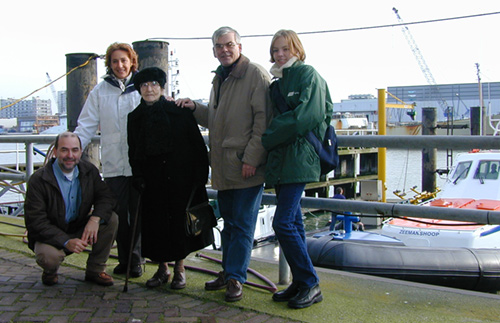
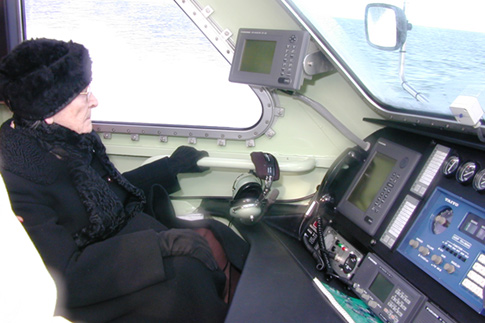
 Jo
Bongaerts and Karel Dahmen grew up together at Roermond in the south
east of the Netherlands near the German border. They became good
friends and were both students at Delft University when Germany invaded
the Netherlands. They escaped to England aboard the Zeemanshoop and briefly served on Dutch merchant ships but their lives then took different paths.
Jo
Bongaerts and Karel Dahmen grew up together at Roermond in the south
east of the Netherlands near the German border. They became good
friends and were both students at Delft University when Germany invaded
the Netherlands. They escaped to England aboard the Zeemanshoop and briefly served on Dutch merchant ships but their lives then took different paths. 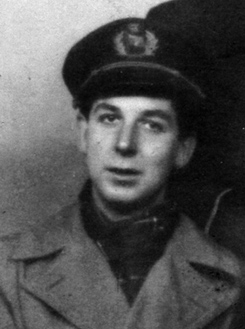
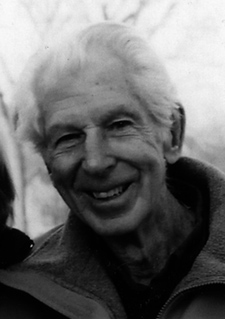 Karel Dahmen was one of the four students who deserve most of the credit for bringing the Zeemanshoop and its passengers to safety. His
decision to cycle from Delft to Scheveningen after hearing the
broadcast announcement of the surrender of Netherlands forces changed
the course of his life. After arrival at Dover aboard HMS Venomous he joined the SS Jupiter under Captain Dekker as assistant engineer before joining the Royal Netherlands Navy as an Ordinary Seaman (OD) on the HNMS Jacob van Heemskerk where he became the RDF Operator.
Karel Dahmen was one of the four students who deserve most of the credit for bringing the Zeemanshoop and its passengers to safety. His
decision to cycle from Delft to Scheveningen after hearing the
broadcast announcement of the surrender of Netherlands forces changed
the course of his life. After arrival at Dover aboard HMS Venomous he joined the SS Jupiter under Captain Dekker as assistant engineer before joining the Royal Netherlands Navy as an Ordinary Seaman (OD) on the HNMS Jacob van Heemskerk where he became the RDF Operator. 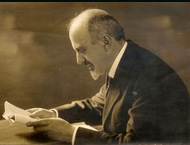 Gustav Alexander
Georg Goldschmidt (on right) was born in Berlin on the 25 April 1878. He
studied law at universities in Berlin, London and Paris (Sorbonne) and
practiced law in Berlin. He married Gertrud Therese Arnheim, a 23 year
old nursery school teacher, on the 19 June 1911 and they had two
children, Werner and Irene. In 1915 he was conscripted into the German
army and because of his knowledge of languages he was given the job of
"eavesdropping" on radio transmissions of British and French army units in
France. After the war he returned to his law practice in Berlin and
was closely associated with Dr Oscar Cohn, a social democrat member of Parliament.
In 1930 he was appointed Legal Advisor to the Minister of Justice.
Gustav Alexander
Georg Goldschmidt (on right) was born in Berlin on the 25 April 1878. He
studied law at universities in Berlin, London and Paris (Sorbonne) and
practiced law in Berlin. He married Gertrud Therese Arnheim, a 23 year
old nursery school teacher, on the 19 June 1911 and they had two
children, Werner and Irene. In 1915 he was conscripted into the German
army and because of his knowledge of languages he was given the job of
"eavesdropping" on radio transmissions of British and French army units in
France. After the war he returned to his law practice in Berlin and
was closely associated with Dr Oscar Cohn, a social democrat member of Parliament.
In 1930 he was appointed Legal Advisor to the Minister of Justice. 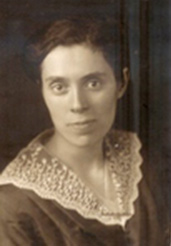 Having fled Germany for the Netherlands it must have come as a terrible shock having to flee a second time but the entire family was extraordinary fortunate to find places aboard the Zeemanshoop. On being landed at Dover by HMS Venomous
on the 15 May the Dutch nationals left for London by train and were
taken care of by the Netherlands Emergency Committee. Gustav and his
wife were stateless but born in Germany; his son had a German passport
and his Dutch wife lost her Dutch nationality when they married. They
were "enemy aliens" and were taken to the police station, interrogated
and held overnight. The following day they were taken to London by
train and husbands and wives were separated, most of the men were sent to
Pentonville prison in north London and the women to Holloway, a prison for women.
Having fled Germany for the Netherlands it must have come as a terrible shock having to flee a second time but the entire family was extraordinary fortunate to find places aboard the Zeemanshoop. On being landed at Dover by HMS Venomous
on the 15 May the Dutch nationals left for London by train and were
taken care of by the Netherlands Emergency Committee. Gustav and his
wife were stateless but born in Germany; his son had a German passport
and his Dutch wife lost her Dutch nationality when they married. They
were "enemy aliens" and were taken to the police station, interrogated
and held overnight. The following day they were taken to London by
train and husbands and wives were separated, most of the men were sent to
Pentonville prison in north London and the women to Holloway, a prison for women.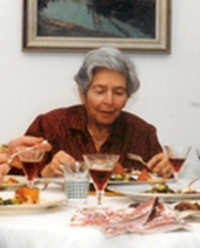
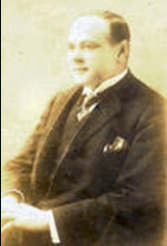 He restarted his law studies - in Dutch - at the University of Leiden
and on qualifying cum laude in 1935 as LL.M (Master of Law) joined the law firm of
Arnold Hijman and Amandus Wolfsbergen in Rotterdam and remained with them until 1940.
He married Inès Jeanne Daniels (left), the daughter of Gustav Daniels (on right), a Director of a
shipping company in 1938 (on right). She was a Jew, born in Antwerp in 1910 but
had been
living in Rotterdam since 1913 and had Dutch nationality. In November
Werner renounced his German nationality and applied for Dutch
citizenship but his application was still pending in May 1940. They
left Rotterdam on the 14 May to join his parents at their home in The
Hague just
hours before the German Sicherheitsdienst (SD, security service), called at their home.
The whole family went to Scheveningen and succeeded in getting a place
on the over crowded Dutch lifeboat.
He restarted his law studies - in Dutch - at the University of Leiden
and on qualifying cum laude in 1935 as LL.M (Master of Law) joined the law firm of
Arnold Hijman and Amandus Wolfsbergen in Rotterdam and remained with them until 1940.
He married Inès Jeanne Daniels (left), the daughter of Gustav Daniels (on right), a Director of a
shipping company in 1938 (on right). She was a Jew, born in Antwerp in 1910 but
had been
living in Rotterdam since 1913 and had Dutch nationality. In November
Werner renounced his German nationality and applied for Dutch
citizenship but his application was still pending in May 1940. They
left Rotterdam on the 14 May to join his parents at their home in The
Hague just
hours before the German Sicherheitsdienst (SD, security service), called at their home.
The whole family went to Scheveningen and succeeded in getting a place
on the over crowded Dutch lifeboat. 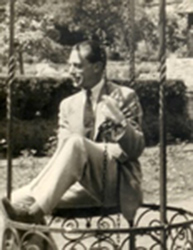 Diplomatic
action by the Dutch ministry of Justice, the Dutch Ministry of War and
the British Ministry of War led to their release in
1941. Inès Goldschmidt in January when she gained employment in the
canteen of the
barracks of the Princess Irene Brigade in Wolverhampton and Werner when he joined the Brigade in April.
The Brigade was formed in January 1941 from troops who had escaped from
the Netherlands and conscripts living in Britain and named after the
daughter of Princess Juliana and Prince Bernhard.
Diplomatic
action by the Dutch ministry of Justice, the Dutch Ministry of War and
the British Ministry of War led to their release in
1941. Inès Goldschmidt in January when she gained employment in the
canteen of the
barracks of the Princess Irene Brigade in Wolverhampton and Werner when he joined the Brigade in April.
The Brigade was formed in January 1941 from troops who had escaped from
the Netherlands and conscripts living in Britain and named after the
daughter of Princess Juliana and Prince Bernhard. 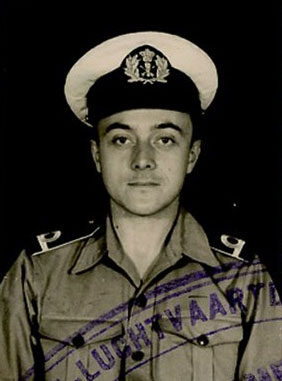
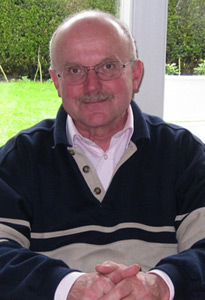
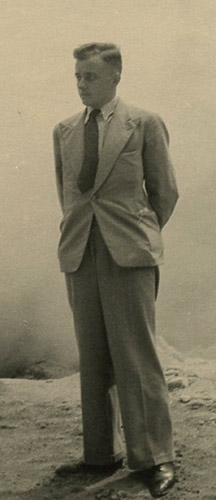
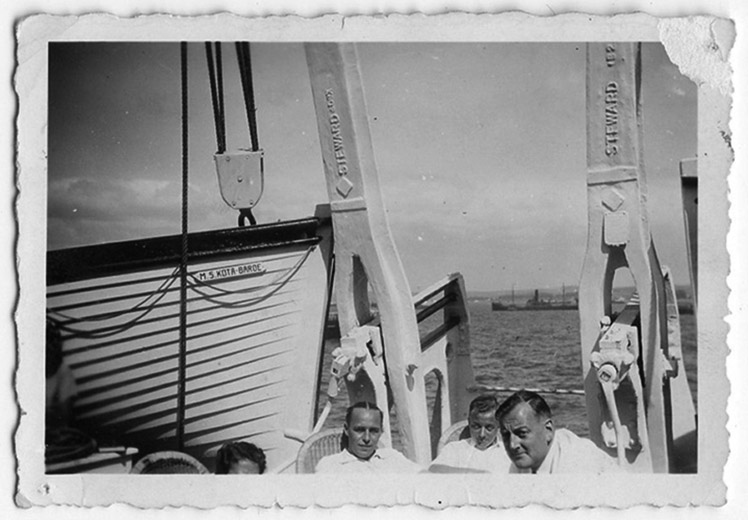
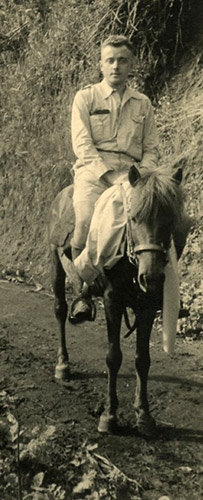
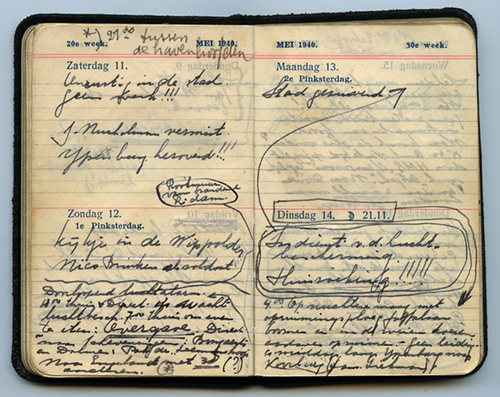
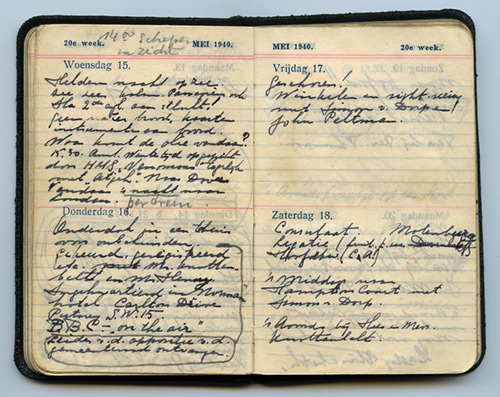
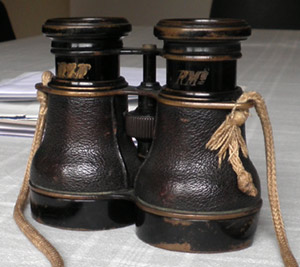 It
is very evident from both descriptions that he relished the opportunity
to seize command of his crew of students and tackled each problem as it
arose with prudence and common sense.
It
is very evident from both descriptions that he relished the opportunity
to seize command of his crew of students and tackled each problem as it
arose with prudence and common sense. 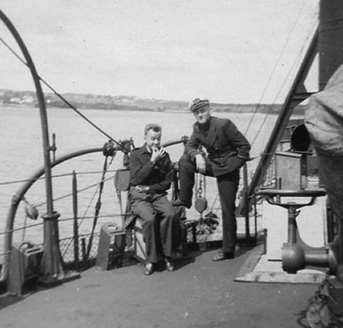
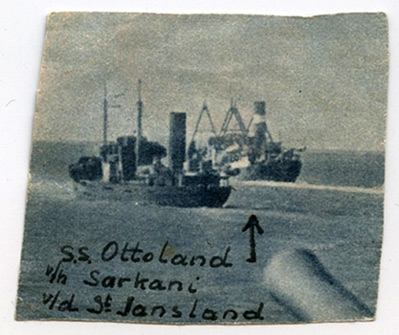
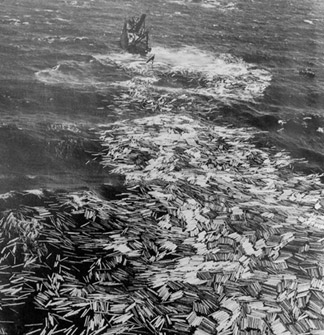
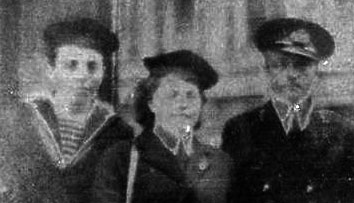 His service record gives no details of postings between his return to
England in October 1942 and being appointed as a maintenance engineer
in the Royal Air Force Volunteer Reserve (RAFVR) in October 1943. He
was part of the (Dutch) Service Echelon 6320 until the 15 June 1944
when he was posted to 320 Squadron (London) until 1 September
1945. He may have continued to be dogged by ill health as his
next posting was to the headquarters of Naval Air Forces at
Scheveningen, the small harbour from which he set out on the Zeemanshoop in May 1940, and he remained there until the 15 June 1946.
His service record gives no details of postings between his return to
England in October 1942 and being appointed as a maintenance engineer
in the Royal Air Force Volunteer Reserve (RAFVR) in October 1943. He
was part of the (Dutch) Service Echelon 6320 until the 15 June 1944
when he was posted to 320 Squadron (London) until 1 September
1945. He may have continued to be dogged by ill health as his
next posting was to the headquarters of Naval Air Forces at
Scheveningen, the small harbour from which he set out on the Zeemanshoop in May 1940, and he remained there until the 15 June 1946. 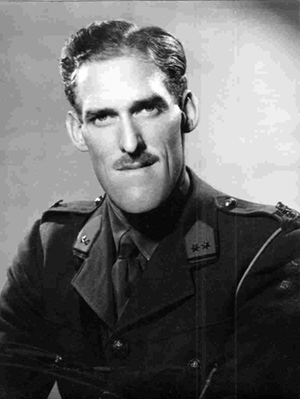 Marien de Jonge was born at Weert, a small town in the south east of
the Netherlands, on the 25 September 1911, the oldest son of Jhr Ir.
Johan Maurits de Jonge and Jkvr. Pauline Clasina Berg. They were not wealthy but the family were
Jonkheer (Jhr.), minor aristocrats, with a long and distinguished
history, and his father was an
engineer working on the construction of a railway bridge at Weert.
Marien de Jonge was born at Weert, a small town in the south east of
the Netherlands, on the 25 September 1911, the oldest son of Jhr Ir.
Johan Maurits de Jonge and Jkvr. Pauline Clasina Berg. They were not wealthy but the family were
Jonkheer (Jhr.), minor aristocrats, with a long and distinguished
history, and his father was an
engineer working on the construction of a railway bridge at Weert. 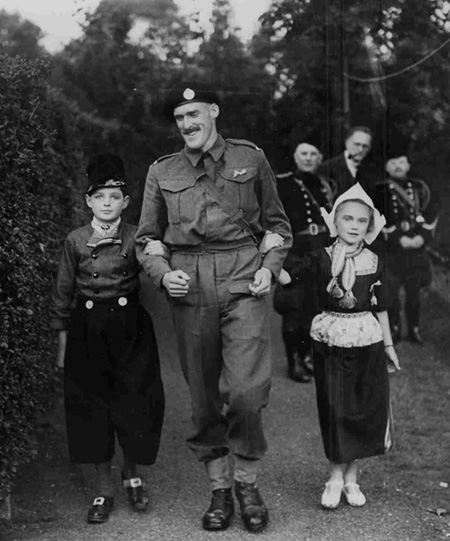
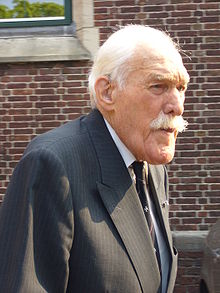
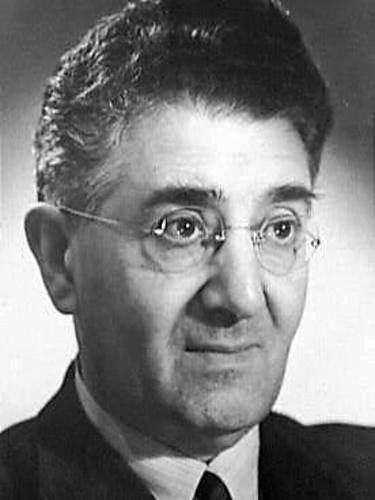
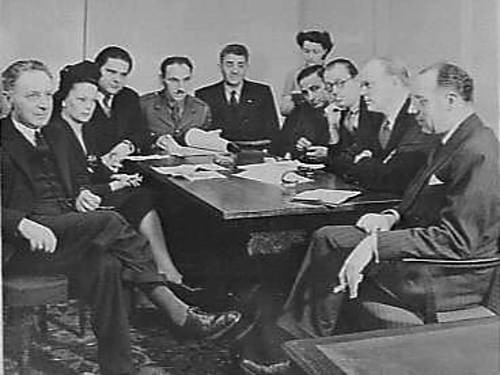
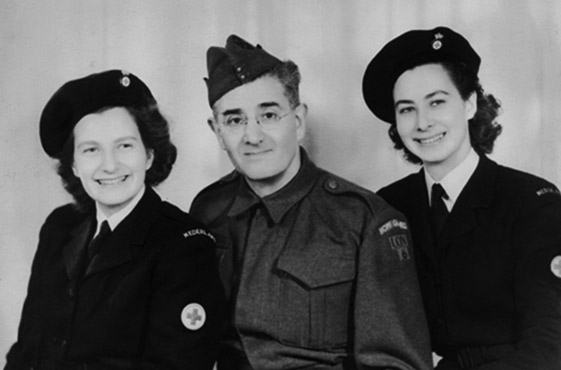
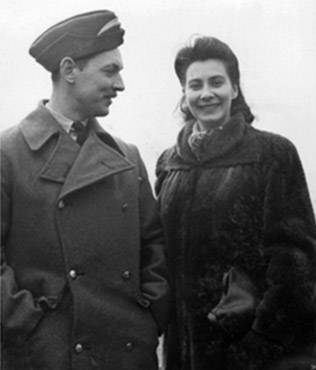
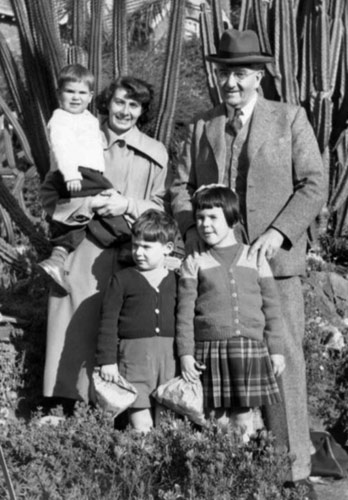
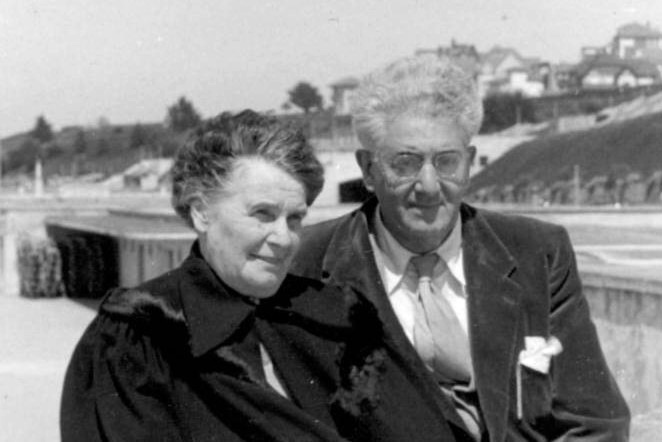
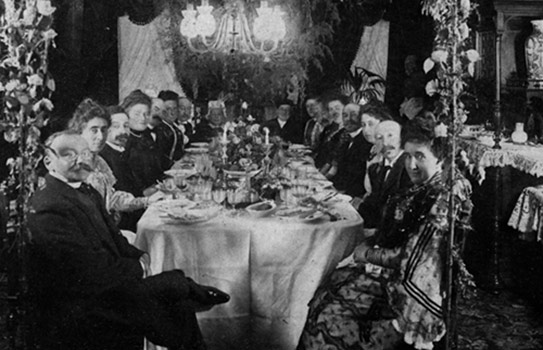
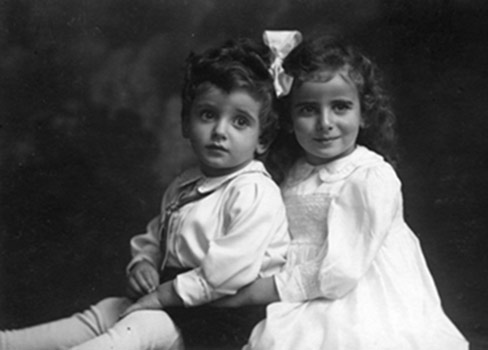
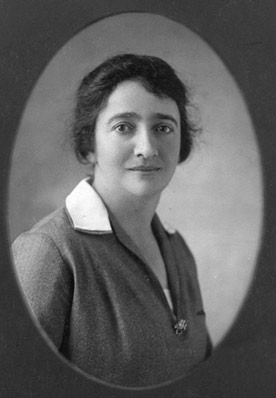
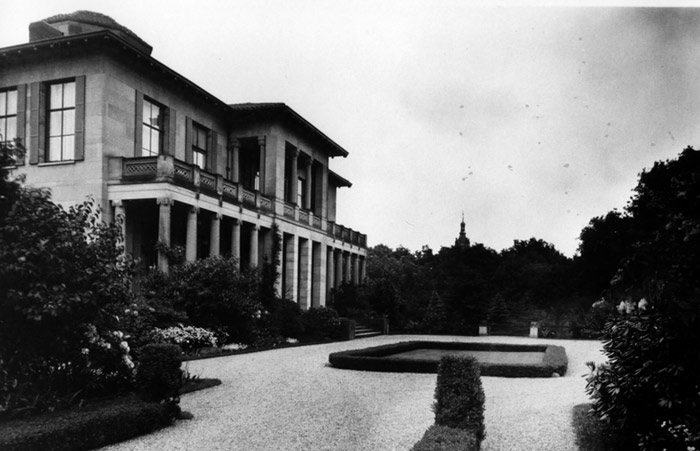
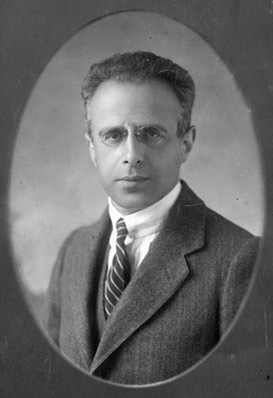
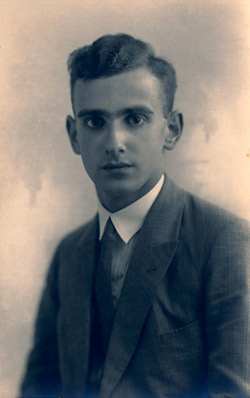
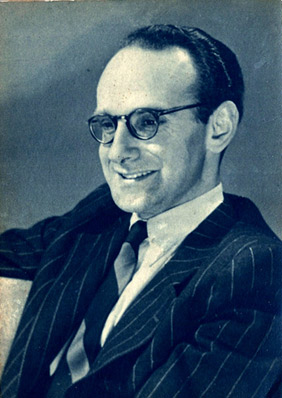 Understandably, Herman Marx (photographed on left in 1937 when he was 23 and on the right in his forties) preferred not to dwell on the tragic circumstances under which he left the Netherlands aboard the Zeemanshoop and he told his family in England almost nothing about the voyage. Paul Conroy
Marx outlines the story of his father's life after release from internment:
Understandably, Herman Marx (photographed on left in 1937 when he was 23 and on the right in his forties) preferred not to dwell on the tragic circumstances under which he left the Netherlands aboard the Zeemanshoop and he told his family in England almost nothing about the voyage. Paul Conroy
Marx outlines the story of his father's life after release from internment: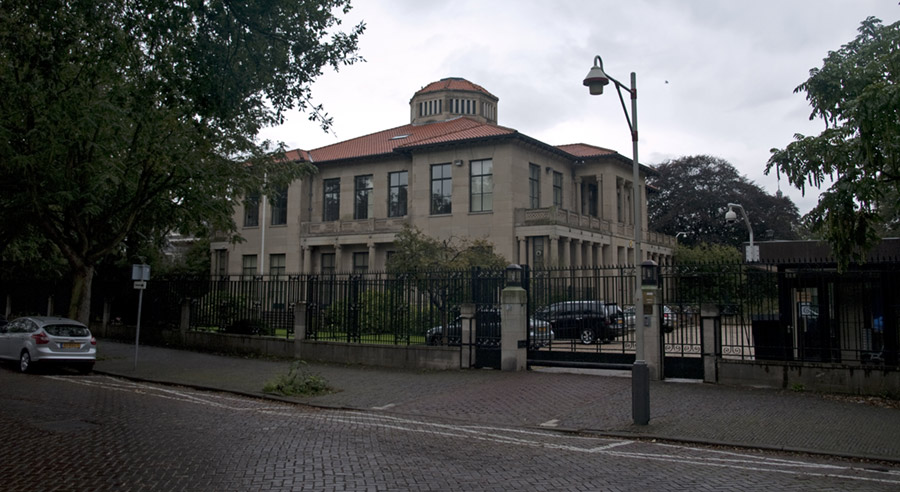
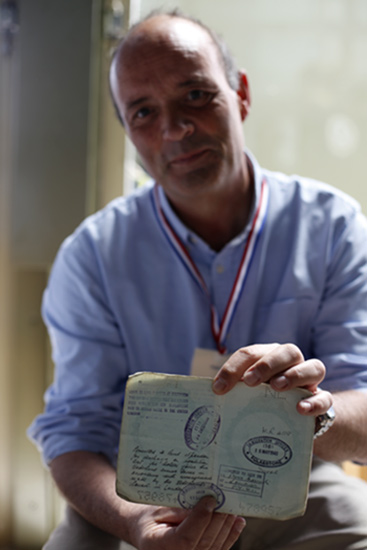
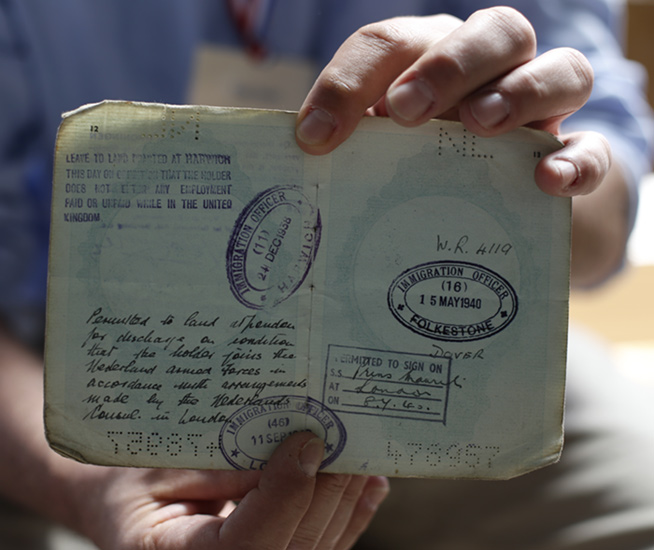
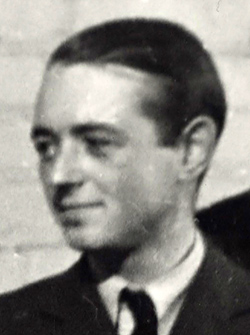 Lou Meijers (nickname 'Loekie' - 'Lucky Lou'?)
was born on the 27 January 1920 at Groningen in the north of the
Netherlands near the German border. His father, Pieter Gillis Meijers,
was an agricultural engineer at a proefboerderij (an agricultural research station) and his mother, Jannetje Tollenaar, taught agriculture at the high school in Groningen.
Lou Meijers (nickname 'Loekie' - 'Lucky Lou'?)
was born on the 27 January 1920 at Groningen in the north of the
Netherlands near the German border. His father, Pieter Gillis Meijers,
was an agricultural engineer at a proefboerderij (an agricultural research station) and his mother, Jannetje Tollenaar, taught agriculture at the high school in Groningen. 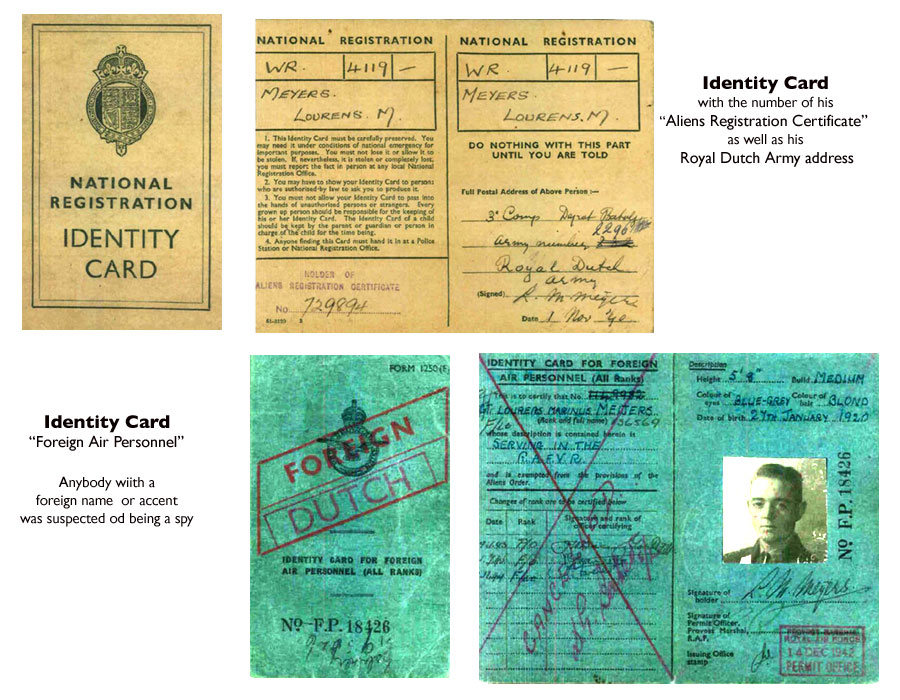
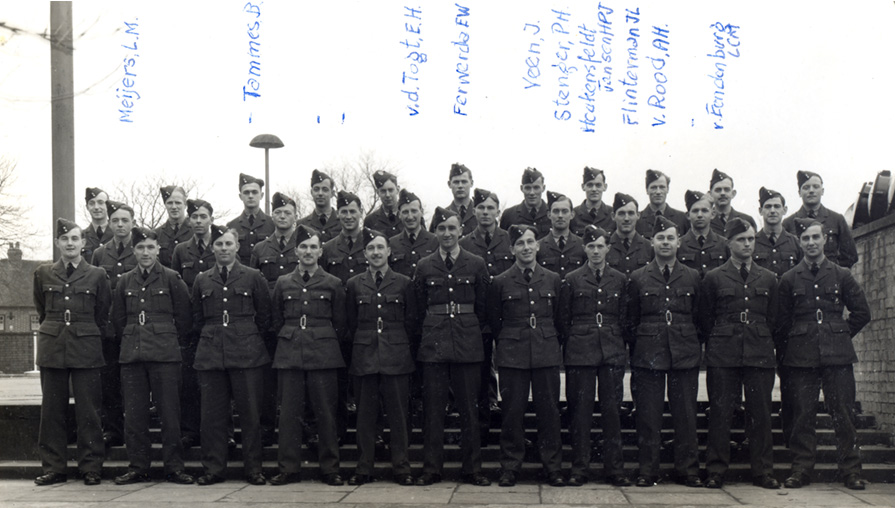
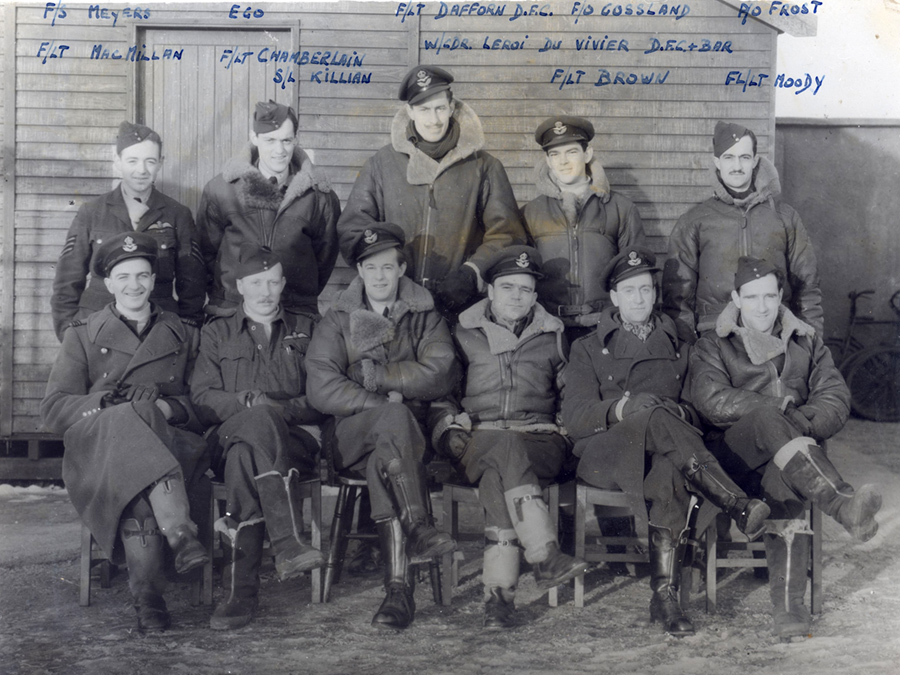
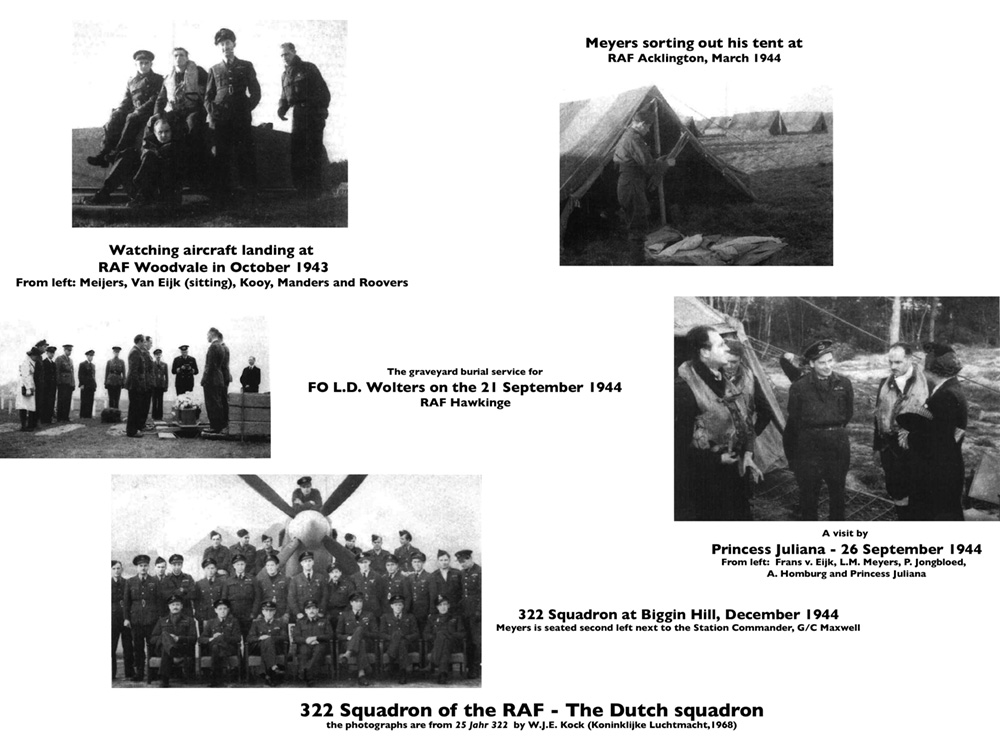
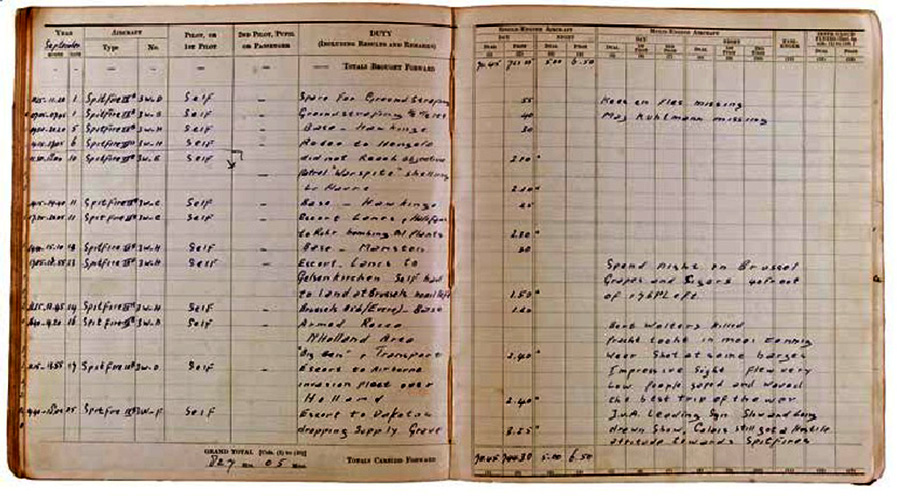
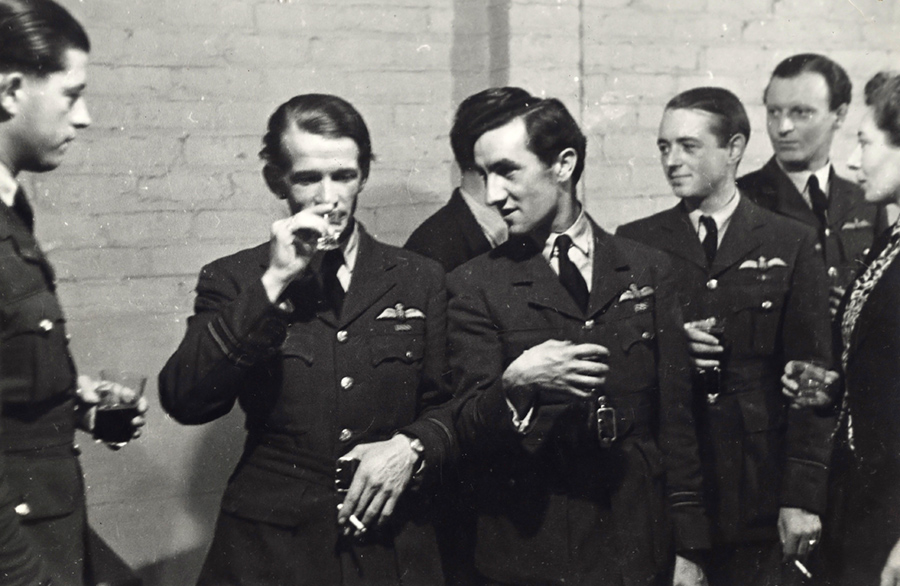
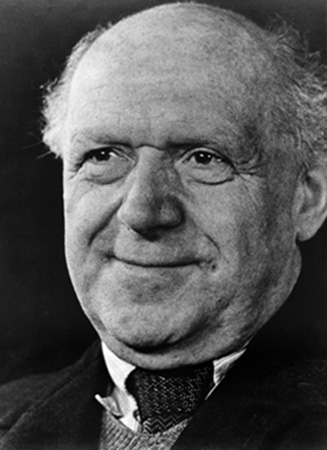
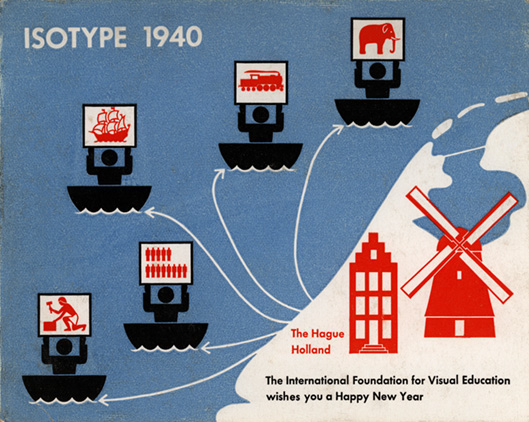
 Marie’s experience of internment is better documented than Neurath’s –
she was interviewed for a book on the internment of women. From other
refugee accounts, we know that the emotional impact of internment was
very varied. For some prisoners it was traumatic, particularly for
those who had already experienced the Nazi concentration camps. Both
Marie and Otto took it remarkably well. Separation from one another was
painful, though they told the authorities that they were married, and
so were able to meet after a few months (Marie was in a women’s camp in
a different town on the island). In letters written after his release,
Neurath insisted it was not a terrible experience for him. He wrote:
Marie’s experience of internment is better documented than Neurath’s –
she was interviewed for a book on the internment of women. From other
refugee accounts, we know that the emotional impact of internment was
very varied. For some prisoners it was traumatic, particularly for
those who had already experienced the Nazi concentration camps. Both
Marie and Otto took it remarkably well. Separation from one another was
painful, though they told the authorities that they were married, and
so were able to meet after a few months (Marie was in a women’s camp in
a different town on the island). In letters written after his release,
Neurath insisted it was not a terrible experience for him. He wrote: 
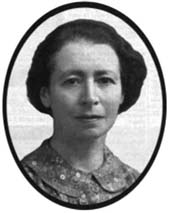 Leo Polak aged 50 and his wife Lucie Polak (neé van den Bergh), 53, were both lawyers;
they were a prosperous Dutch family living in a modern Bauhaus style
house (at Van Oldenbarneveldtlaan 121) close to the second (inner harbour) at Scheveningen. It was within the called so Sperrgebiet (Prohibited Area) which prevented many of those in The Hague desperate to escape from going to the harbour to look for a boat.
Leo Polak aged 50 and his wife Lucie Polak (neé van den Bergh), 53, were both lawyers;
they were a prosperous Dutch family living in a modern Bauhaus style
house (at Van Oldenbarneveldtlaan 121) close to the second (inner harbour) at Scheveningen. It was within the called so Sperrgebiet (Prohibited Area) which prevented many of those in The Hague desperate to escape from going to the harbour to look for a boat.